

We’ve all felt it firsthand—the Web Push notification market is anything but predictable. One moment, you see performance improving and budgets increasing; the next, policies change, unsubscribe rates spike, and the industry shifts toward questions about the long-term stability of the format. This is not only perception—the push ecosystem is being reshaped by evolving platform policies, stricter enforcement, and wider changes in how digital advertising ecosystems operate.
Today, push notifications remain a core channel for real-time engagement across industries, from Utilities and eCommerce to Finance and Travel. Adoption continues to grow, and the global market for push notification services—across all channels, not just Web Push—is projected to expand steadily over the next decade (from $902M in 2025 to $1.36B in 2035), reflecting continued demand for direct user engagement formats.
However, beneath these growth figures lies a more nuanced picture: Web Push is evolving under increasing platform and privacy constraints, and marketers are continuously adapting their strategies to maintain performance. This raises a key question: is Web Push losing momentum, or is it entering a longer transformation phase that will redefine how the channel operates?
Let’s take a closer look at the state of the Web Push advertising market—its key challenges, main trends, and where opportunities still remain for those adapting to this evolving environment.
Key developments in Web Push: 2024–2025 overview
The fourth quarter of 2024 brought important changes to the Web Push ad ecosystem. Google introduced updates making the unsubscribe option more accessible on Android and strengthening its Google Safe Browsing (GSB) policies.
What was behind these changes
From a platform perspective, these updates were driven primarily by user experience and ecosystem integrity concerns. Over time, push notifications had become associated with intrusive messaging and misleading content, particularly from low-quality sources. As a result, Google introduced stricter policies—most notably targeting content itself, with certain phrases now restricted or prohibited.
Google’s policy direction can be interpreted as an effort to:
- Increase user control and transparency
- Reduce abusive or deceptive notification practices
- Improve overall engagement quality
These changes show a wider shift toward better content quality and clearer user consent.
What these changes entailed
These updates had a noticeable impact. With easier opt-out mechanisms, users began unsubscribing more actively. Therefore, some publishers experienced a reduction in subscriber bases and revenue pressure.
Soon after, a wave of bans followed, with certain domains being flagged or restricted based on compliance and quality signals. Only on our platform, unsubscribe rates increased significantly in some cases—by 30-40%. While we quickly adapted and supported clients in recovering performance, the disruption was widely felt. Some players managed to adjust, while others struggled to adapt at the same pace.
Rather than a typical saturation cycle where weaker players naturally exit, these changes marked the beginning of a broader structural adjustment in the ecosystem. As stricter enforcement continues in 2026, it’s becoming clear that adaptation is no longer optional—it’s essential.
So what does this mean for the future of Web Push—is it still on the table? Let’s first look at the global forecast from Statista, based on real market data.
The data-based forecast for the Web Push ad industry
Despite continuous market fluctuations and ongoing policy tightening in 2026, the forecast for the Web Push advertising industry remains cautiously optimistic. However, the overall trajectory clearly indicates a maturing market phase rather than a high-growth expansion cycle.
Global market dynamics
- Global web push ad spending in 2026: ~US$3.22 billion
- Projected global market volume by 2030: ~US$3.61 billion
- CAGR (2026–2030): ~2.88%
Based on this compound growth rate, the market is expected to expand at a steady but moderate pace over the forecast period:
- 2026: ~US$3.22 billion
- 2027: ~US$3.31 billion
- 2028: ~US$3.41 billion
- 2029: ~US$3.51 billion
- 2030: ~US$3.61 billion
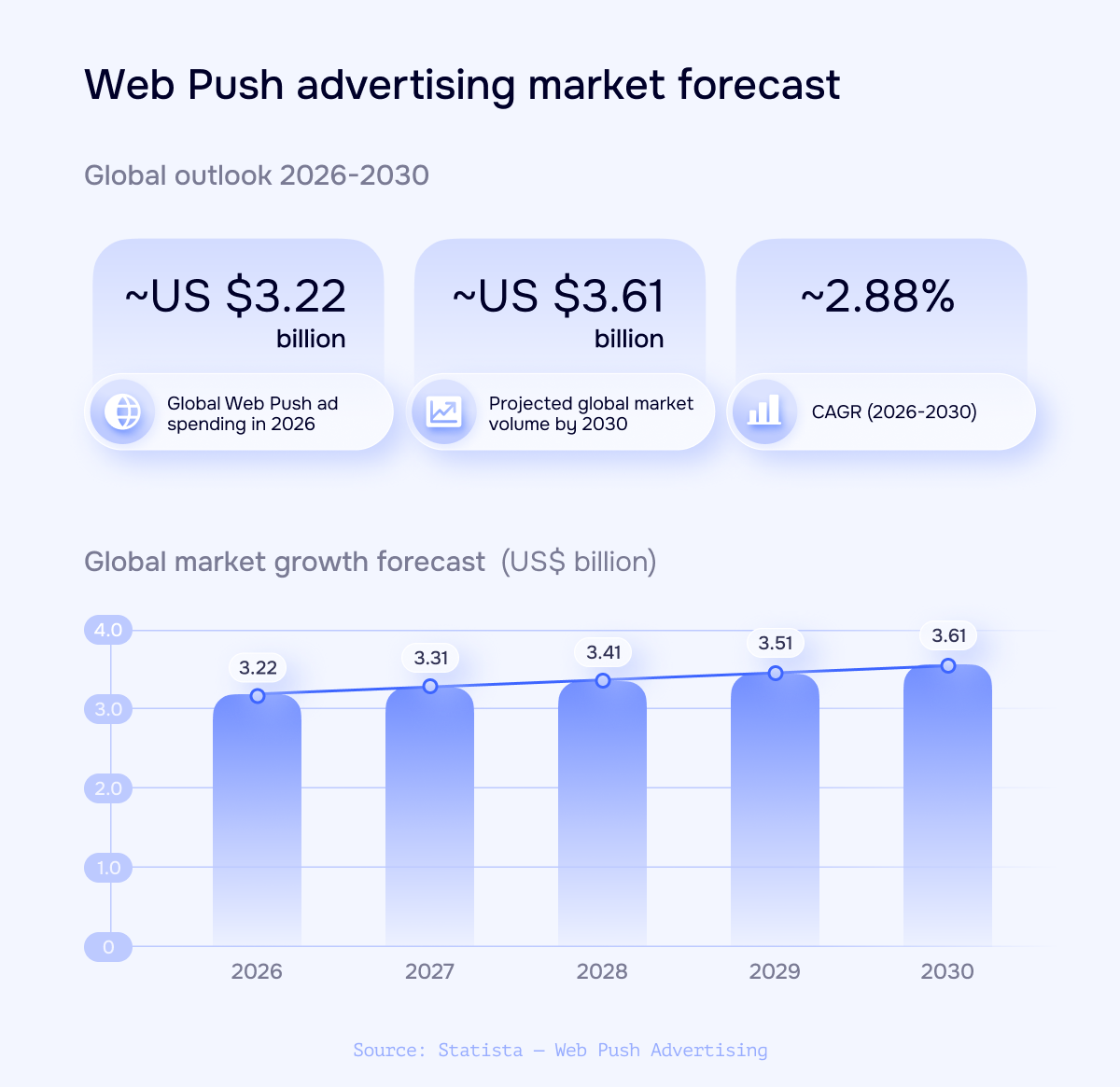
While the market continues to grow, the pace of expansion is relatively modest. A CAGR of ~2.88% indicates that Web Push advertising is transitioning into a stable, maturity-stage channel rather than maintaining its earlier trajectory as a high-growth performance channel.
The current trajectory suggests a shift from earlier expansion phases toward a more stable and incremental growth pattern. This moderation reflects normalization within the broader digital advertising ecosystem rather than stagnation.
At the same time, the slowdown reflects a combination of factors, including ongoing policy tightening, evolving privacy standards, and increasing platform-level constraints that influence how push-based channels scale. These conditions do not reduce overall growth, but they do reshape its structure and pace.
Regional forecast snippets
Statista regional breakdowns also indicate continued growth through 2029–2030, although at different rates depending on market maturity:
- Americas:
~US$1.53 billion (2026) → ~US$1.69 billion (2030), CAGR ~2.52% - G7 countries:
~US$1.85 billion (2026) → ~US$2.03 billion (2030), CAGR ~2.32% - MENA region:
~US$59.08 million (2026) → ~US$64.45 million (2030), CAGR ~2.20% - EAEU markets:
~US$29.71 million (2026) → ~US$32.81 million (2030), CAGR ~2.51%
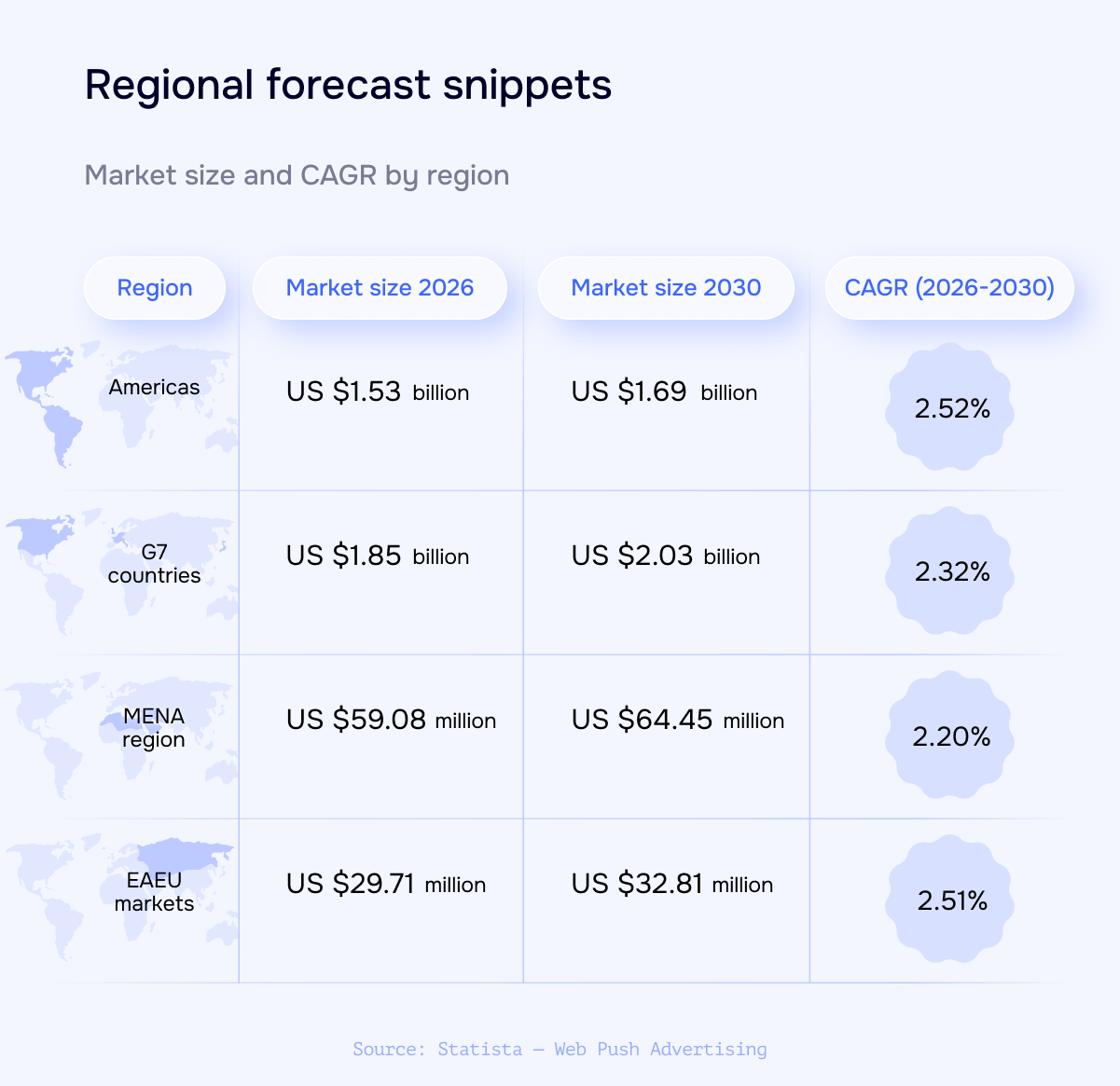
Growth is quite similar across regions, but there are small differences. The G7 and MENA regions grow more slowly, which suggests these markets are already quite mature and expanding at a steadier pace. The Americas and EAEU markets show slightly higher growth, but still within a mature market range.
Overall, regional differences mainly reflect varying levels of market maturity and digital advertising penetration rather than fundamentally different growth directions.
Interpreting the outlook: Web Push trends in 2026 and beyond
Building on Statista’s market outlook, the Web Push advertising industry is expected to continue growing steadily, with increasing emphasis on real-time and targeted messaging. At the same time, platform policies and enforcement mechanisms continue to evolve, and as mentioned earlier, this reflects an ongoing evolutionary process.
What we are observing is not a sudden disruption, but a gradual restructuring of how the channel operates. Stronger enforcement and improved detection systems are reducing low-quality activity and improving overall ecosystem standards.
This shift introduces short-term volatility in performance. However, it should not be seen as a sign of decline. Rather, it reflects a transition toward higher standards—and, ultimately, higher CTR.
As the overall volume of messages decreases, the pressure on users is reduced. Over time—typically within about a year—this leads to increased user engagement and improved CTR.
The rise of higher-quality players
The Web Push market is gradually shifting toward a more quality-driven environment, where lower-quality traffic channels are being reduced and replaced by more compliant and performance-oriented participants.
Up until late 2024, the market was relatively balanced: new players were entering while others were leaving, creating a form of dynamic stability. As enforcement tightened, this balance began to shift more visibly, affecting both supply and demand across segments.
In some cases, reduced supply led to short-term increases in traffic costs, while in others, reduced competition improved efficiency for higher-quality advertisers. This reflects a standard market rebalancing process that becomes more visible during periods of structural change.
Over time, this shift is expected to improve the overall perception of the format across market participants, increasing demand from Tier 1 and Tier 2 advertisers.
In the short term, however, this transition is accompanied by fluctuations in volume and performance. Despite this, the overall direction of the market remains stable, with gradual growth and a more clearly defined structure.
The industry is moving from a volume-driven phase toward a performance- and ROI-oriented environment. As a result, all participants are going through adaptation:
- Old approaches no longer deliver the same results.
- New optimization frameworks are still forming.
- Traffic providers are developing new technical solutions to align with stricter standards.
- Advertisers are rebuilding funnels, refining targeting logic, and focusing more on LTV rather than short-term ROI.
The road ahead for Web Push
What we are seeing is a transition from scale-driven growth toward a more results-driven and structured market environment. While volatility remains in certain segments, the underlying trajectory is stable and continues to show steady, incremental expansion.
In practical terms, this means:
- Inventory becomes more selective but higher quality
- Low-quality traffic continues to decline
- Each subscriber becomes more valuable over time
The market is gradually shifting toward formats that deliver clear user value. For advertisers, publishers, and networks, the key takeaway is clear: success is increasingly defined not by volume, but by relevance and quality of engagement. This leads to a shift toward more informative and meaningful ads, rather than those designed solely to maximize CTR. Those who adapt to this approach early will be best positioned to succeed.
We, as an ad network, continue to evolve alongside these changes. Players who adjust early to this new environment are likely to benefit the most as the market becomes more structured and quality-driven. If you’re ready to move in the same direction, we’re here to help you navigate this transition and grow within the new Web Push landscape.