The modern world is all about simplicity. The ways things were done at the end of the last century don’t apply to today’s reality, with our hectic pace of life and the desire—and, more importantly, the real ability—to achieve results quickly and efficiently.
During the early days of online advertising (1994–2000), websites acted as mini ad networks themselves, manually managing placements, tracking clicks (if possible), and billing advertisers. Website owners contacted companies directly to sell ad space, negotiated prices and durations, and manually inserted the code for each advertiser.
Real-time bidding and programmatic automation were beyond even the wildest imaginations of that time. Luckily, it’s 2025, and we can enjoy all the perks of modern technology. In this article, we’ll explore the essence of ad auction, the role of ad networks in the process, and how you can succeed and get your ads served.
What is an ad auction?
There are countless websites and apps around the world with ad placements they want to fill. On the other side are advertisers with their campaigns, competing for the best ad spots. But how is it decided which ad appears in which inventory? This is where an ad auction comes into play—a real-time, automated process in which digital advertising space is bought and sold based on advertisers’ bids.
Typically, the higher the bid, the better the chance an ad has to be shown. Securing the highest bid can also help an advertiser reach a user early in their session, which increases the likelihood of conversion. However, it’s not just about the bid. Other factors such as the creative’s CTR also influence which ad is displayed, making the process more complex than an auction, say, at Sotheby’s. Let’s sort everything out.
How an ad network distributes traffic
An ad network has ad inventory on one side and ads on the other, now it needs to mix them in such a way that it is fair and profitable for both sides.
Imagine a user opens a news website (that has already partnered with the ad network). This triggers an ad impression—an opportunity to show an ad. The ad network analyzes the user data (location, device, interests) to decide which ads would fit this impression most.
Then among those who made it through, the network automatically selects the highest-value ad for that impression based on bids and some other factors (like CTR) and instantly delivers this ad to the user. This advertiser pays the ad network for impressions/clicks won. And the network pays a fee for using this website’s placement.
This is how ad distribution works—it’s designed to match ad inventory with ads for maximum profit for both the website owner and the advertiser. It’s important to note that ad distribution is a broad process, with the ad auction being one of its core mechanisms. In an auction, the principle is crystal clear: the highest bid always wins and captures the traffic until the campaign budget runs out. But within the larger process, traffic is distributed fairly—even among those with lower bids, just in smaller proportions.

How to avoid overspending: Smart bid models
Now all this begs the question: what bid should you set for each of your ads? When bidding in traditional auctions with an unknown bid increment, it’s easy to get overwhelmed, trying not to overpay while still offering enough to win. The situation is similar in ad auctions. But while in a traditional auction you would observe the first bids to identify the pattern, in ad auctions there are several strategies available depending on the bid model you choose.
Though you can always ask the support team for recommended bids, there’s no 100% guarantee that those bids will work their magic—you should always test yourself. That’s why it’s a good idea to use smart bid models to run your tests to avoid overpaying and collect the needed white- and blacklists for scaling: SmartCPC, SmartCPM, and CPA Goal. The key lies in how they work.
SmartCPC and SmartCPM automatically adjust your bids to the average price of the zone you laid your eyes on and free you from the headache of choosing the bid yourself. CPA Goal not only tweaks your bids to match the average auction price, but also fine-tunes them to achieve a specific CPA. To do that, the system dynamically manages bids by lowering them in expensive zones, raising them where conversions come cheaper, and removing low-performing ones. For zones without any conversions, it adjusts bids using overall campaign averages.
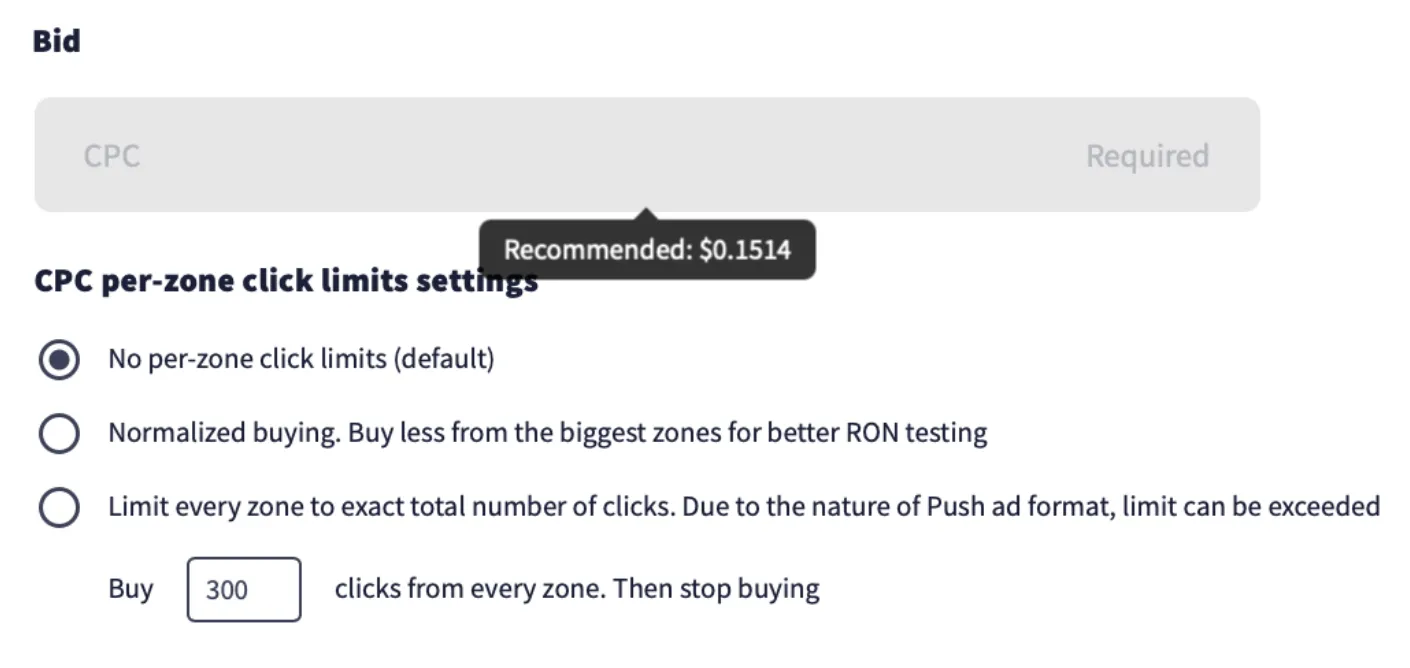
If you opt for traditional bidding models such as CPC and CPM (we highly recommend using them after tests when you scale your campaigns, or if you are an experienced affiliate marketer and know your bids well), you’ll need to set your own bids. With these models, you define a fixed bid, and each time a click (or a thousand impressions) occurs, that amount is deducted from your campaign balance. However, even in this case—when working with RollerAds—you’ll see bid recommendations during campaign setup, regardless of whether you choose Push, OnClick, or Direct Click formats.
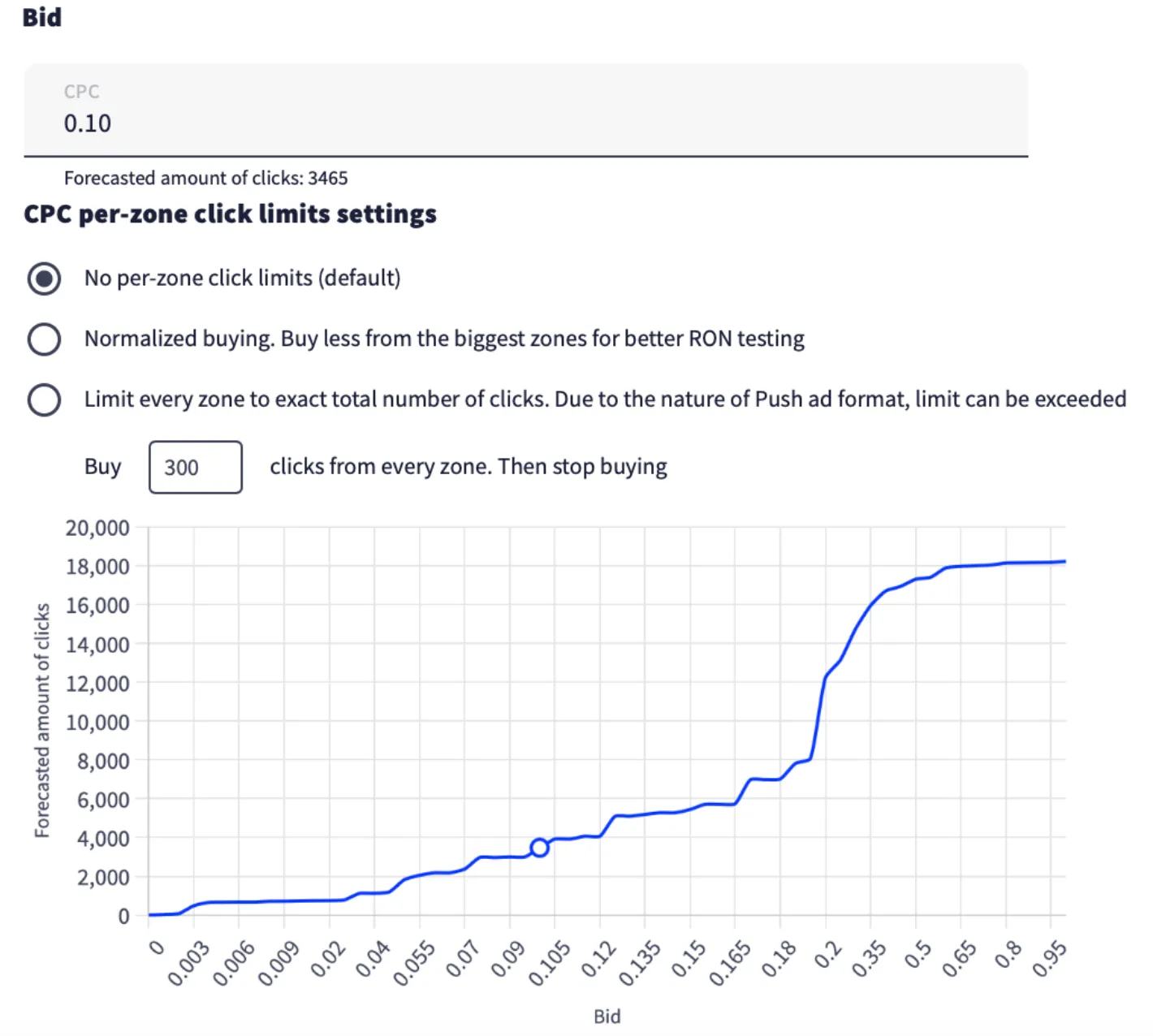
Also, when you enter the bid amount, you’ll see the traffic estimator curve below to get an approximate idea of how much traffic you can expect.
Tips & tricks to win
Though ad distribution is a rather complicated process with lots of nuances, there are a few tricks to help your ads climb the ranks. Let’s dive in and make your campaigns not just successful, but downright profitable.
1. Know your bids. When you work with OnClick or Direct Click, ad allocation is based predominantly on the highest bid, so the higher your bid amount, the more chances your ad has to get into the limelight.
2. Push your CTR. In push notification campaigns, even with a CPC bid, ad distribution runs on the eCPM model. This means that besides the bid, the system also considers the creative’s CTR to help publishers get the most out of their traffic. The key takeaway: focus on your creatives and refresh them regularly.
To make your life easier, we’ve developed Creatives Library, where you can take a peek at the best-performing high-CTR creatives for your targets and get inspired. It’s important to note that we don’t use our clients’ creatives, so your ideas and designs remain yours, always.
3. Check your ranking and adapt. Always check your ad campaign’s position in the auction. Don’t hesitate to reach out to your account manager or use the traffic estimator tool in your campaign dashboard. Competition constantly changes, so the more flexible you are with your bidding, the greater advantage you’ll have.
4. Play with high bids. Don’t be afraid to set high bids with SmartCPC/CPM bid models. Some channels can be extremely well performing, but competition there is also high. Setting the highest possible bid will ensure you’ll be getting more traffic from the best channels, while other channels will be purchased at the same price as if you had a lower top bid for your ad campaign.
To sum it all up
Ad distribution and auctions might seem complex at first, but at their core, they’re all about matching the right ads with the right users at the right time—and maximizing results for both advertisers and publishers. Understanding how ad allocation works gives you a major advantage and, if you put theory into practice, helps you stay ahead of the competition. Remember to keep your creatives fresh, monitor your bids, and pay attention to performance metrics. With these insights and the smart tools available on our platform, running efficient, profitable campaigns is no longer a lottery ticket—it’s a strategy you can master.
Want to know more about earning with ad networks or making your campaigns and traffic more profitable? Jump into our blog—we have plenty of valuable insights to share with you. Or register right away and start profiting today!