
There’s a product. There’s an audience that might need it. Now, how do you connect the two? Affiliate marketing is one way to do it. You promote products to relevant audiences and earn a commission when that promotion leads to a specific result.
While this sounds great, there are a few steps between finding an affiliate program and starting to earn from it. These include:
– Finding the right products to promote
– Creating content or ad campaigns around those products
– Optimizing them for the best possible return
That may sound like a lot to figure out at first, but affiliate marketing is an exciting industry to get into. We know that from experience. We’ve been in the game for over seven years, and we wouldn’t trade it for anything else.
So let’s go over how affiliate marketing works, what it takes to start earning, and which mistakes to avoid along the way.
What is affiliate marketing?
As mentioned above, affiliate marketing is when you promote another company’s product and earn a commission when someone takes a specific action after following your link.
The required result will vary depending on the product being promoted. It could be a purchase, a subscription to a channel or service, an app install, or another defined conversion. Because you are only rewarded when that happens, tracking matters a lot. It shows which results came from your campaigns and what actually needs to be optimized.
How it works in practice
At its core, the affiliate marketing process would look something like this:
- A business creates an offer: the product, the action it will pay for, the payout, and the countries and devices it accepts.
- You pick an offer and get a unique tracking link.
- You send traffic to that link. It might come from a site you own, a social account, or paid advertising.
- A user follows the link and completes the required action.
- The tracking system then records the conversion, and the payout is added to your balance.
More metaphorically: the tracking link acts like glue holding this all together. It lets businesses easily separate conversions that came through your link by carrying an identifier that tells them specifically which affiliate sent the visitor.
Who are the main participants in affiliate marketing?
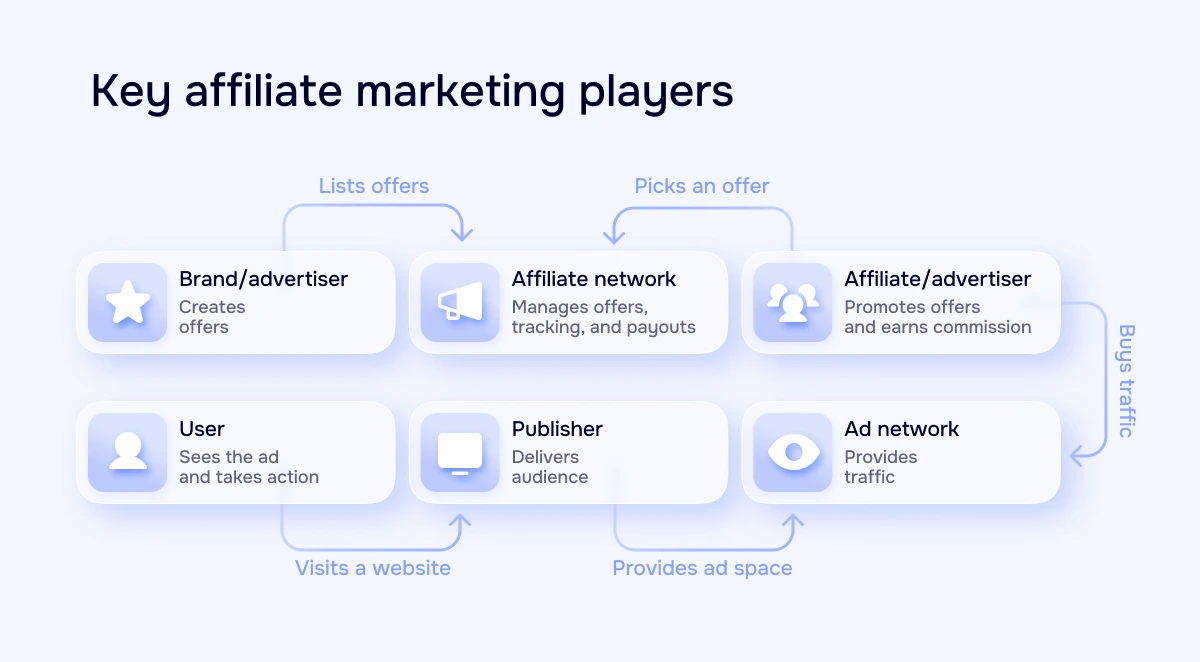
The broader affiliate marketing ecosystem involves six participants: brands, advertisers, publishers, affiliate networks, ad networks, and users. However, four play the main operational roles: advertisers, publishers, affiliate networks, and ad networks. Brands and users are still part of the ecosystem, though.
Advertisers, also called affiliates
Advertisers can also be referred to as affiliates. From the brand’s (and affiliate network’s) perspective, they are affiliates because they are promoting the brand’s products or offers. From an ad network’s perspective, they are advertisers because they are the ones buying traffic to promote those offers.
In many cases, you will find that the same person can be called either an affiliate or an advertiser depending on the platform they are using.
Publishers
Publishers are the individuals or companies that own websites or applications with an audience. They already have traffic, but instead of running affiliate campaigns themselves, they can monetize that traffic by allowing ads to be shown to their users.
The publisher earns from the traffic they provide, while advertisers use that traffic to promote their offers.
Affiliate networks
Affiliate networks are platforms that gather offers from many different brands in one place. Instead of having to sign separate agreements with 20 different companies, you can use one platform with one set of statistics and one payout schedule.
Ad networks
Ad networks connect the two sides of the traffic market. Advertisers buy traffic, publishers provide it, and the ad network handles things such as targeting, ad delivery, and payments.
For more information on this topic, we have a separate piece explaining what an advertising network is and how to choose one.
Traditionally, these parts of affiliate marketing often lived on separate platforms. You might find an offer through one network, buy traffic through another, and monetize your own website somewhere else. We will come back to this later in the article.
How do advertisers make money?
An affiliate buying traffic earns money when the revenue from conversions exceeds the cost of acquiring that traffic. In the simplest terms: the difference between those two numbers is the profit. The scheme below shows the entire process, from choosing an offer to earning a profit.
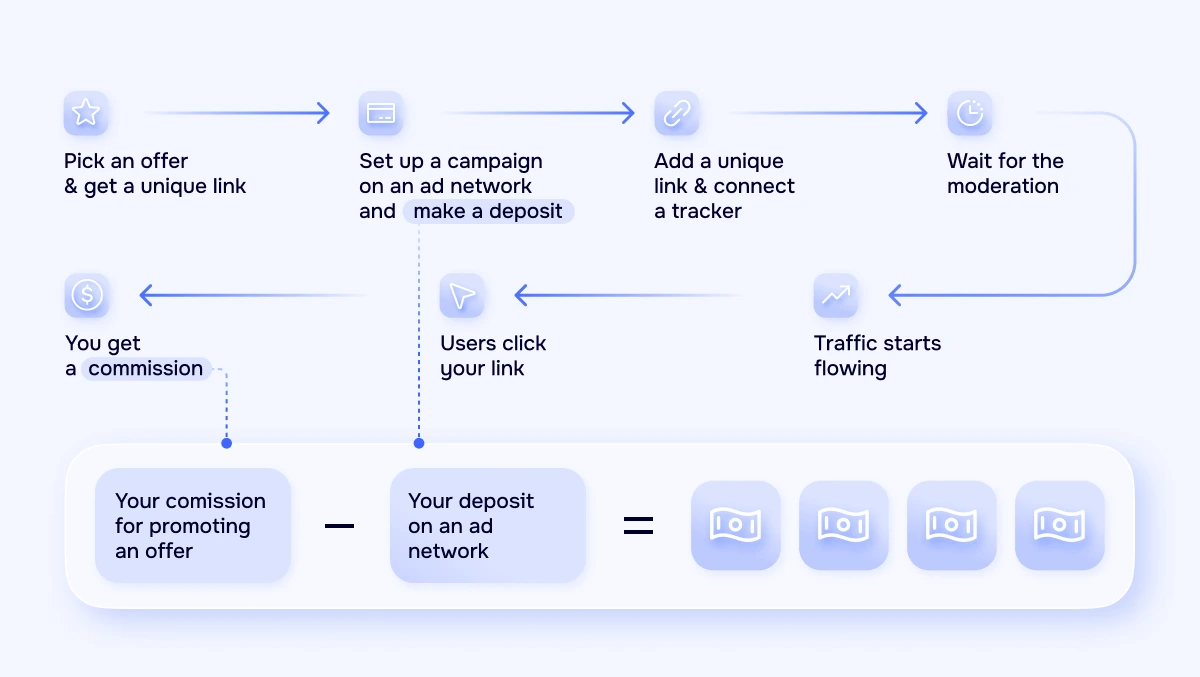
As an example, in one of our own campaigns, we took a browser installation offer from the RollerAds offer catalog and promoted it using OnClick traffic in Brazil on desktop for 15 days.
- Ad spend: $439.02
- Revenue from conversions: $755
- Profit: $315.98
- Return on investment (ROI): 71.97%
Nothing really exotic happened in this case. Just an offer, a country, and one format. The campaign was monitored daily so we could adjust traffic as the first numbers came in. Those results are of course not guaranteed by any means, and a different strategy could have produced a different result, but the shape of the work is roughly the same across every campaign.
Beginners often underestimate the fact that the gap on day one won’t always be positive. The budget you spend during that period isn’t necessarily wasted, though; it’s the price you pay for crucial information.
How do publishers earn on their traffic?
If you own a website with an audience, you can monetize the traffic your website already receives. By working with an ad network, you provide ad space, while the network fills it with relevant ads. You earn revenue when your users see or interact with these ads.
The amount of money you earn will depend on various factors, such as your audience’s GEO, the size and quality of your audience, the monetization type and strategy you choose. Some monetization models take time to build up revenue, while others can start generating it much sooner.
Take the case study of one of the publishers working with RollerAds. The publisher owns a network of 1,000+ news websites that serve a French audience and reach more than 60 million users each month. In January 2024, they launched push notification monetization across their websites. The results looked like this:
- January: $4,000
- February: $18,500
- March: $31,000
- April: $57,000
- From May onward: around $50,000–$60,000 per month
The number of subscribers also grew from 26,800 after the first month to 760,000 by April. This matters because push monetization builds on the subscriber base over time, so a larger accumulated audience can generate more monetization opportunities.
This publisher is much larger than the average website owner, of course. Smaller websites can use the same methods, just at a different scale.
For a more in-depth discussion of publisher monetization, see our website monetization guide.
How to start affiliate marketing step by step
If you are wondering how to start affiliate marketing with no experience, you do not need to start with five GEOs, four traffic formats, and ten different affiliate programs at once.
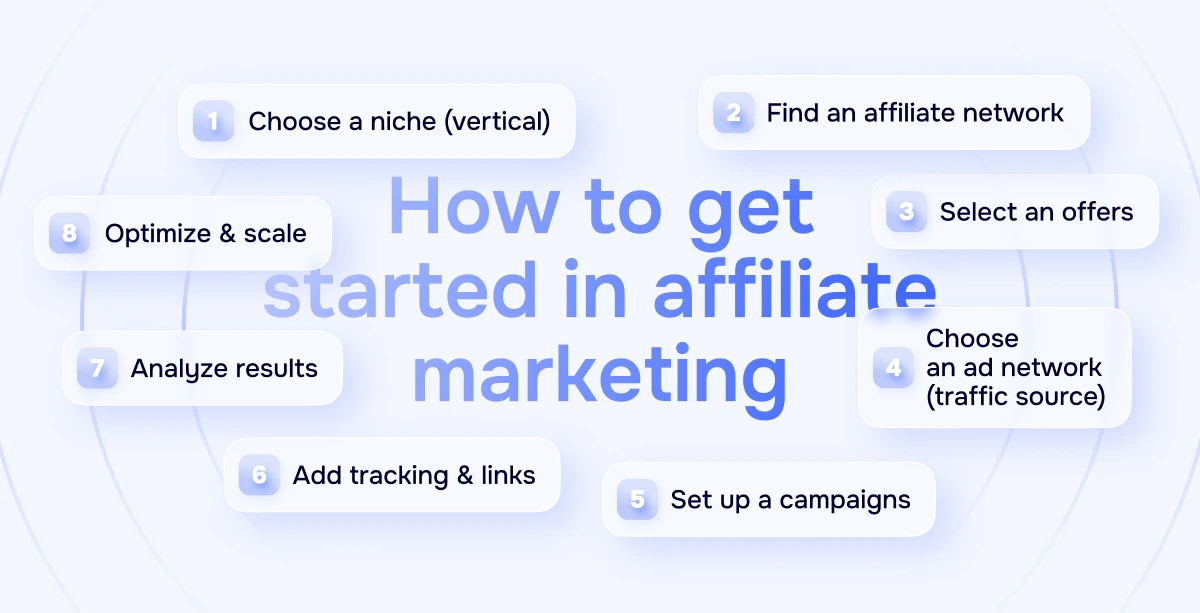
Choose a niche (vertical)
Choose the category of products you want to focus on. Some examples of verticals include Software & Utilities, VPNs, Browser extensions, eCommerce, Finance, and Surveys.
As a starting point, RollerAds account managers would often recommend Software & Utilities. A fairly broad vertical with plenty of familiar products and subniches, from VPNs and antivirus software to PDF readers. An important part is sticking with one or two verticals long enough to learn how they behave in different scenarios. Switching every few days makes the data much harder to read.
Find affiliate programs or networks
You can work with the brand’s affiliate program or an affiliate network. The second offers more choice and convenience by keeping all offers, statistics, and payouts in one place.
Look at the payment schedule, minimum payout requirements, and available payout methods. It might be tempting to choose the program with the largest payout, but make sure that the other terms work with your budget and traffic.
When comparing affiliate networks, also consider the range of available offers and whether you can filter them by GEO, device, vertical, payout, and other criteria.
The point is to make sure the network actually has enough relevant options for the traffic you plan to work with before you start comparing individual offers.
Choose affiliate offers that fit your goals
An offer page tells you more than just the payout.
It tells you which GEOs are accepted, which devices and operating systems are allowed, which types of traffic are acceptable, and what action counts as a conversion, and more. And, of course, all the restrictions that go with it.
Just as you would want to make sure your car fits in a garage before you buy one, match your planned traffic to the offer’s requirements. A desktop-only offer doesn’t help when you’re sending mobile traffic. It’s an easy mistake to make, but usually an expensive one.
Pick your traffic source
Once you have an offer in mind, choose how you will bring users to it. If you plan to buy traffic, an ad network can give you access to a large pool of users across different GEOs, devices, and traffic formats.
Not every traffic source or ad format works equally well for every offer. Push notifications reach users who have opted in to receive them. OnClick delivers a full-page ad through a pop-style interaction. Direct Click combines several high-intent traffic channels, including intentional clicks on publisher-site links and domain redirects. They behave differently, so the traffic source and format should match the offer and not be chosen in isolation.
This is also where you should consider factors such as available GEOs, traffic volume, targeting options, bidding models, and traffic costs. Start with a setup that fits the offer and gives you enough room to test before expanding.
Create and launch a campaign
If you have your own audience, this is where you create the content that leads users to the offer, such as a review, comparison, article, or social post. If you plan to buy traffic, this is where you set up the campaign—your creatives, targeting options, bids, budget, and landing page.
1–2 creatives are often insufficient for a complete test. Plan on creating multiple variations. See which ones convert best, and update them with new versions once their performance declines. The quantity isn’t what matters here; the quality of each creative should also support the value proposition of the product or offer and work properly across the devices you are targeting.
Add and track your affiliate links
For every single conversion, you have to make sure that attribution occurs properly. Postback tracking is commonly used with paid traffic to send conversion data from the affiliate network or tracker back to the traffic source. Tracking links and IDs can also help with attribution when using traffic you already have access to, such as social media or your own audience.
We recommend setting up your tracking before putting serious budget into a campaign. Without it, you can see how much you spent on traffic, but you won’t know which parts of the campaign generated those conversions.
Analyze your performance
The overall result of an account or campaign is usually made up of many smaller parts. Once the data arrives, drill down by traffic zones, creatives, GEO, device, OS, bid, and conversion data.
This will help you determine whether a poorly performing account or campaign still has profitable segments hidden inside it, and vice versa. Ultimately, this helps you identify the real cause of the results before making your next move.
Optimize and scale
To optimize is to shift your budget away from what is underperforming and toward what performs better. This can be accomplished by removing weak zones, adjusting bids for stronger-performing traffic, pausing tired creatives, and limiting how often people see them.
You will know when to scale when you have something worth scaling. Increase your budget in increments and make one major adjustment at a time. For example, if you are testing a new GEO, operating system (OS), bid strategy, and creative all at once, you may find the results of the test meaningless because you won’t know whether it was the GEO, the OS, the bid strategy, or the creative that made the difference.
Speaking about GEO, we’ve recently compiled the best-performing combinations of GEOs, ad formats, and verticals—check them out to make an informed decision about where to start your tests.
What is the right ad network for my use case?
Depending on what you want to use it for, several factors may influence which ad network is right for your needs. However, the following considerations will help in most cases, regardless of your goals:
- Which GEOs and/or device types am I able to reach with my ad network?
- How many different ad format options, targeting options, and bidding methods does the ad network have at its disposal?
- Does the ad network allow me to track and report on metrics related to my campaigns, either through its own reporting tools or through third-party tools?
- Are the ad network’s moderation policies fair, reasonable, and accessible? Are its payment terms reasonable, and are there clear expectations regarding minimum deposit amounts needed to activate an account?
- Is it possible for me to receive regular support from an account manager or customer service representative if I have questions or need further information about using the ad network?
One more important consideration: How many separate platforms do I need to effectively manage all aspects of my advertising workflow?
At this point, it is worth noting that RollerAds has evolved into a full-cycle advertising platform where the same account provides access to the main parts of the workflow: picking offers, launching campaigns, and generating revenue from traffic on your own websites. This means you do not have to jump between separate platforms for each part of the process. Furthermore, the offer catalog within RollerAds currently contains over 300 offers—including in-house deals and offers from other providers.
Offers from the RollerAds catalog can also be launched directly on RollerAds traffic from the offer page, with the relevant campaign fields already filled in. We covered the whole process in our recent article about our built-in affiliate network.
Affiliate marketing mistakes beginners should avoid
Many common rookie mistakes aren’t complex. Most come down to small decisions made when setting up a campaign that can become costly once traffic starts coming in. The points below are partially based on an interview with RollerAds account managers Kate and Mary.
Overlooking offer requirements
Each and every offer you’ll be promoting will have its own requirements and limitations. Be sure to review the GEO, device, operating system, type of traffic, and how the conversion takes place before activating your campaigns. Also take the time to go through the offer yourself just like a typical user would. This can reveal many things that are easy to overlook in the description.
Advertising products that are not relevant to your traffic
It is very important to match the product you’re advertising to the traffic you are targeting. An excellent example of this would be browser extensions. If the extension requires a desktop install, then there is no need to send mobile traffic for installs since these users cannot accomplish the required action. This same idea applies to any offer that is limited by device, OS, or a specific user flow.
Not tracking conversions
Conversion tracking enables you to track performance, make adjustments to optimize campaigns, and scale them. As RollerAds account manager Kate put it, “Without it, you’re flying blind; you can’t measure performance, optimize campaigns, or scale.”
Skipping the initial tests
RollerAds account managers say that running individual campaign tests as “wide” as possible makes it harder to determine the cause of whatever results you get. In other words, start off with a limited setup (i.e., one GEO, one OS) and expand from there once you’ve got some data to work with.
This does not mean that wide tests have no place. When you start working with a new ad network, a broader test (Run-of-Network) can help you understand which GEOs, devices, formats, or other segments are worth exploring. The key is to know what you are trying to learn from the test.
Each test should answer one question. If too many different elements are changing at the same time during a test, the answers get jumbled together. Use broader tests to map out opportunities, then narrow the setup to identify and optimize what works.
Running tests with the wrong bid models
Test with the right bidding model.
Testing with bids that are too low can limit the traffic coming into the test, while bids that are too high can burn through the test budget before you learn anything.
SmartCPC and SmartCPM automate bidding in different ways, while CPA Goal optimizes toward a target cost per action.
We have a detailed comparison between CPC, SmartCPC, and CPA Goal if you’d like to see how these bid models work in practice.
Creating low-quality content
Poor-quality imagery, carelessly written copy, and creatives that don’t match the offer can impact performance before your campaign has been given a fair chance to succeed. A second mistake is launching with only one or two creatives and never updating them.
Create multiple versions of your creative and periodically rotate the old ones out so you’re continually comparing what works and what doesn’t. Also make sure your creative matches both the type of device and the actual path users travel after they click.
Expecting results right away
Day 1 isn’t always going to be the deciding factor. Paid campaigns require enough data to allow you to identify trends, while publisher monetization may build over time as the monetizable audience grows.
Don’t stop a test based on the first few results alone. Give it enough time and data to show whether it meets your expectations.
Not communicating with your account manager or support team
Account managers have experience analyzing campaigns across many different markets, offers, and bidding setups. They’ll look at different parts of your campaign, including GEOs, bid models, offers, and other settings, and provide feedback on things that may be easy to miss when you’re working on your own.
While account managers can provide insight and help guide the direction of your testing, they can’t replace testing. Asking questions and getting help early on can save you from wasting money trying approaches that could have been ruled out earlier.
FAQ about affiliate marketing
Can you start affiliate marketing with no experience?
Yes. And one of the easiest ways to get started is to limit the number of variables; i.e., choose only one or two verticals to focus on, set up one GEO, use one traffic format, and track everything right from the beginning. Once you understand what that initial data is showing you, you can start adding more variables and testing new opportunities.
Do you need a website to start affiliate marketing?
No. Owning a website is simply one possible traffic source available to you when using affiliate marketing. It is not required. If you don’t currently have access to an audience, you can always purchase traffic through an advertising network (in addition to other methods). The downside of buying traffic is that it generally requires a budget to fund testing, whereas building an owned audience takes time.
Closing thoughts
A very basic outline of how this works is a company paying for results (a defined action), the affiliate sending traffic to the offer where the action occurs, and a system tracking that traffic so the correct affiliate receives credit (the commission).
Determining which part of the process is actually driving the result is much harder. All or some of the elements involved in running the campaign (offer, traffic, GEO, creative, tracking, bid/cost, and optimization) can affect the success of each campaign. Because of this, your affiliate marketing strategy will largely be built around testing these variables while keeping an eye on what actually changes the results.
When starting out with no experience, start small enough that your data does not become unmanageable. Choose a niche, select an appropriate offer, set up your tracking correctly, and focus on testing one thing at a time before thinking about scaling.
RollerAds has brought together most of what you need to get started with your first campaign inside one account: offers, paid traffic, ways to monetize your website, tracking options, and direct access to both account managers and support. If you are getting ready to start testing your first campaign, make sure you have created an account with RollerAds, and don’t wait until your budget is already spent before asking questions.