Affiliate marketing can get confusing quickly because the same campaign may involve an advertiser, an affiliate network, an ad network, and an affiliate program—all doing different jobs.
The simplest place to start is the affiliate network. It connects advertisers with affiliates looking for products to promote, providing access to offers while handling tracking, reporting, and payouts.
Once you understand where the network sits between the advertiser and the affiliate, the rest of the system becomes much easier to follow. So that is where we’ll start.
What is an affiliate network?
An affiliate network is essentially a platform for advertisers looking to connect with affiliates who can provide traffic to their offers. Each offer defines the action that counts as a conversion and the payout attached to it. For example, if a consumer visits a website by clicking an affiliate’s tracking link and makes a purchase, the affiliate gets paid, and the advertiser gets the conversion.
Affiliate networks have three primary players:
1. The advertiser—the company or person behind the product or service being promoted; they determine what qualifies as a successful conversion (e.g., completion of a survey, signing up for a free trial, installing software, etc.).
2. The affiliate—promotes products/services owned by other companies through a variety of means such as email marketing, social media advertising, paid traffic, and more.
3. The affiliate network—acts as a bridge between the advertiser and affiliate; tracks activity associated with each party; handles payment processing and provides support to affiliates.
Without an affiliate network, an affiliate working with multiple advertisers would have to manage each relationship separately. This can mean dealing with separate reporting, payouts, and agreements for each advertiser.
How do affiliate networks operate?
Once you understand the basic idea, the process is fairly simple:
Advertiser→offer→affiliate network→affiliate→tracking link→traffic→conversion→payout
Here’s what that flow looks like in practice:
An advertiser submits an offer to an affiliate network. The offer includes terms such as: the payout for each qualifying conversion, the GEOs the advertiser accepts traffic from, permitted traffic channels, what counts as a qualifying conversion (completed registration form, completed transaction), and other recommendations.
The affiliate chooses an offer from the network and receives a unique tracking URL. Consumers then reach the advertiser’s landing page through this URL. When the consumer completes a qualifying conversion (and it is reported back to the network), the affiliate network records it.
Payouts do not necessarily occur immediately after conversion. Conversions are often reviewed before payouts are released, so there may be a delay between the moment a conversion is recorded and the moment the affiliate gets paid. This period is often called a “hold” period.
Affiliate networks vs. affiliate programs vs. ad networks
While closely related, each term represents a different segment of the overall affiliate marketing process:
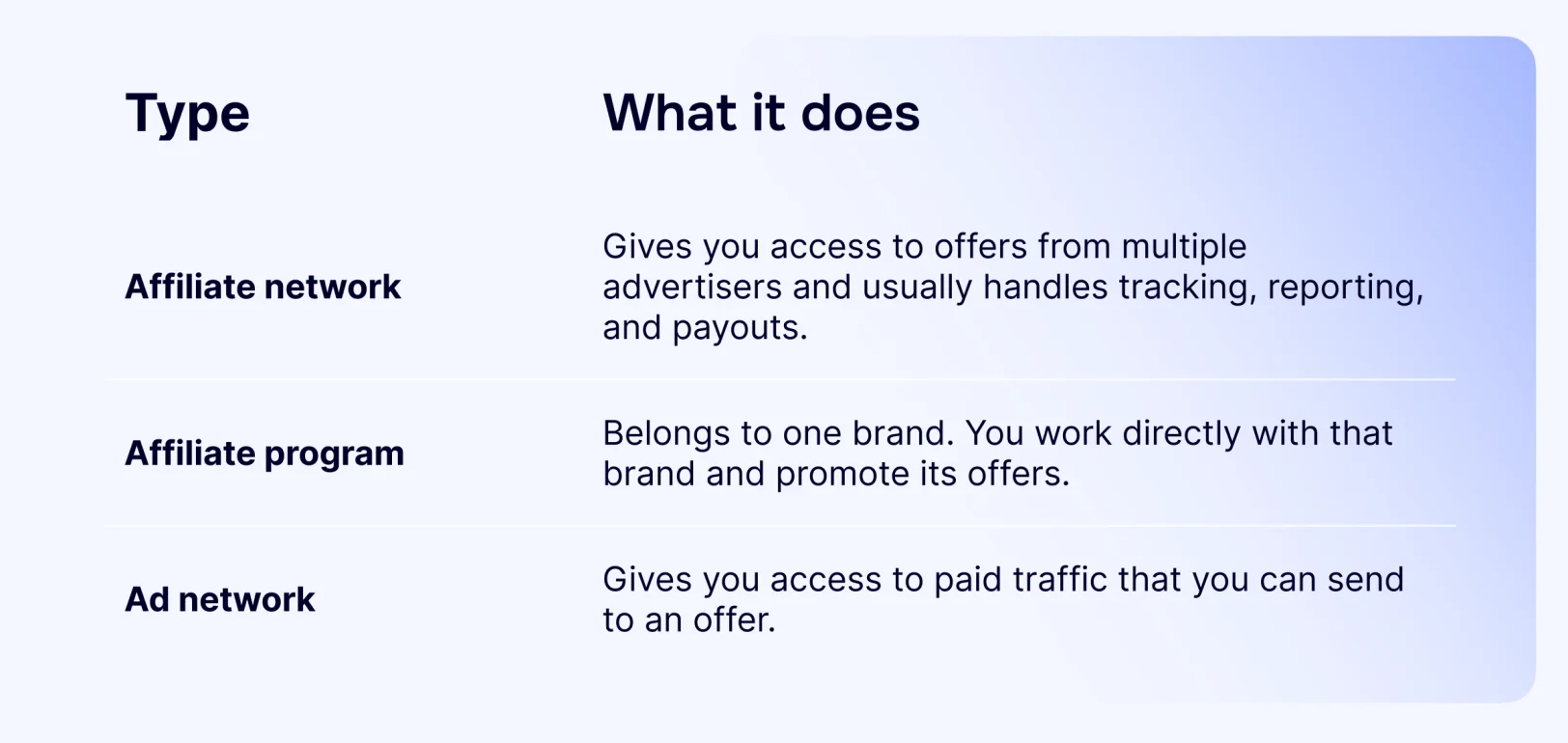
Working directly with a single brand may result in more flexible terms at larger traffic volumes; however, tracking, reporting, payments, and communication are managed separately for each program.
Don’t miss our recent article, where we explain how affiliate marketing works, who the key industry players are, how to get started, and how to avoid common affiliate marketing mistakes.
How do affiliate networks pay affiliates?
How an affiliate gets paid depends on the specific offer. Most offers use one of several standard payment models:
- CPA (Cost Per Action)—the affiliate gets paid for every advertiser-defined qualifying action.
- CPL (Cost Per Lead)—the user completes a lead-generating action, e.g. a registration or form submission.
- CPI (Cost Per Install)—the user installs an application or software product.
- CPS (Cost Per Sale)—the affiliate earns either a flat rate or a percentage of each successful sale made through the affiliate link.
- RevShare (Revenue Share)—the affiliate earns a predefined percentage of revenue generated by referred users.
- Hybrid—a combination of two or more payment models, e.g. CPA and RevShare.
The actions behind those payouts can look very different. In the current RollerAds catalog, for example, desktop software can pay up to $120 per sale, eCommerce up to $50 per sale, credit card trials up to $35 per CC submit, single opt-in sweepstakes up to $7 per opt-in, and app installs up to $5 per install.
While higher payouts may look more attractive, a higher payout does not automatically mean it is a better offer. A $120 software sale asks much more from the user than a $7 single opt-in.
What can you promote through an affiliate network?
Most affiliate networks group offers into verticals. Common examples include:
- Software & Utilities—including VPNs, cleaners, browser extensions, etc.
- Sweepstakes
- eCommerce
- Lead generation
- Finance
- Mobile apps and subscriptions
Your vertical selection should depend on your traffic and whether you can reasonably generate the necessary conversion. The highest payout in the catalog isn’t always going to give you the best return.
For reference, the RollerAds catalog contains 300+ offers across 20+ verticals and 200+ GEOs, generating 20K+ conversions every day. The catalog includes both in-house offers and offers from third-party advertisers. Check it out; you’ll probably find something worth testing.
Are affiliate networks compatible with paid advertising?
Yes. Provided that the offer supports the desired traffic channel, it can be promoted with paid advertising. This is one reason why it is helpful to distinguish between the function of an affiliate network and that of an ad network: the affiliate network gives you access to offers, while the ad network provides the paid traffic you can send to them.
These two parts do not have to be separate. RollerAds combines paid traffic with the CpaRoll affiliate network inside one full-cycle ad platform, so offers and campaigns can be managed from the same account.
There are also some practical advantages to having an affiliate network combined with a traffic source (ad platform):
1. You can launch an offer right from the offer page if you do it on RollerAds traffic, with all the necessary fields already pre-filled.
2. Internal offers go through automated moderation when you keep the original tracking link—the one that is specified in the offer.
Learn more about how to launch RollerAds offers inside the platform with one click and see the steps in detail.
Again, regardless of where you decide to purchase your traffic, you will still need to examine each offer individually for allowed GEOs, devices, and any other restrictions related to that offer.
Frequently asked questions
What is the difference between an affiliate network and an affiliate program?
An affiliate network gives you access to offers from multiple advertisers. An affiliate program belongs to one brand, so the affiliate works directly with that company.
What is the difference between an affiliate network and an ad network?
An affiliate network gives you access to offers you can promote. An ad network gives you traffic that you can send to those offers.
Can I use paid traffic with an affiliate network?
Yes, if permitted by the individual offer. Each offer specifies allowed traffic sources, so check the terms before launch.
How do affiliates track conversions?
Affiliates use a unique tracking URL that shows where a conversion came from. Networks may also forward conversion data to external trackers via postbacks.
Is having a website necessary to participate in an affiliate network?
No. Depending on the network and offer, affiliates may be able to use paid traffic directly or send users through a prelander or push notification. Always check the offer’s GEO and traffic-channel restrictions before launch.
What types of affiliate offers are available through RollerAds?
RollerAds currently has 300+ offers across 20+ verticals and 200+ GEOs, including Software & Utilities, eCommerce, Sweepstakes, Lead generation, Finance, and mobile apps/subscriptions.
Want to take a closer look at real offers? Sign up for RollerAds, then go to the Offers tab. Use filters and sorting by GEO, vertical, payout, and device to see which offers fit your traffic.