Domain monetization changed significantly in 2026. On February 10, Google removed parked domains as an ad surface from its Search Partner Network. Thus, domain owners that had been relying on the “parked” model as their primary monetization route lost a major monetization outlet.
Traffic generated by a domain still needed to be monetized. However, instead of asking “Will this domain generate revenue?”, the question now was “What are my best options for utilizing the traffic I already have?”
While comparing the highest payout listed on a landing page is relatively simple, determining which platform will ultimately provide the greatest financial value based upon factors such as setup time, demand from advertisers, relevance of the content, quality of reporting, features of portfolio management tools, and overall customer support is far more difficult.
Therefore, the purpose of this guide is to cover the key items that should be evaluated prior to choosing a monetization provider for your domain portfolio.
Domain monetization platform checklist
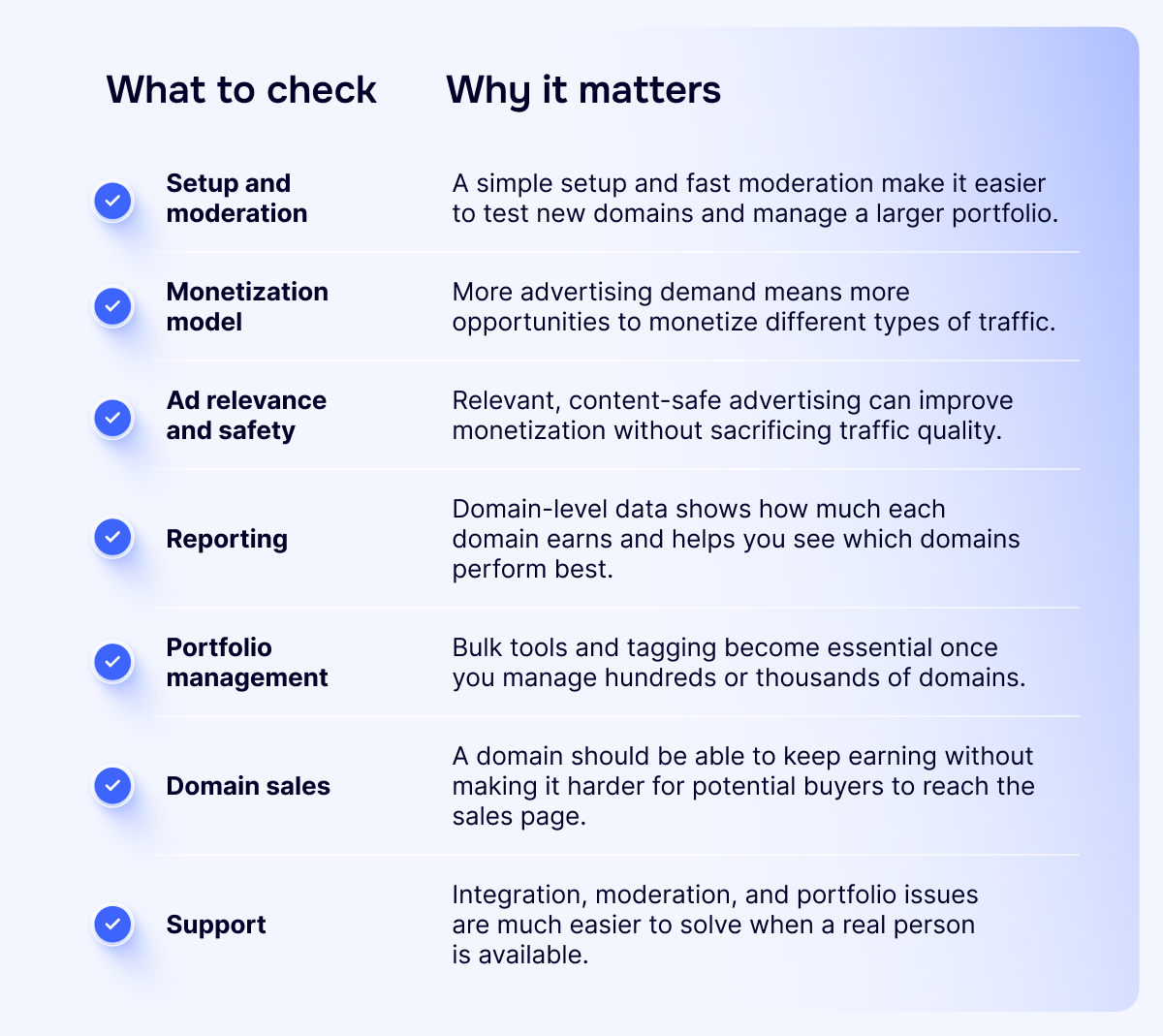
The checklist is simple. The details are where platforms start to look very different.
How easy is it to connect your domains?
Start at the root of the issue: How many hours will it take to get domains earning?
Connecting one domain may be simple, but when you have to do this same task 500-5,000 times, it becomes a significant operational task.
At scale, what matters is how easy the platform makes it to connect and approve a large batch of domains. You should be able to upload a portfolio, get the DNS details you need, and move the domains through moderation without handling every one manually.
RollerAds allows users to enter their domains individually or via bulk upload and provides Name Server or CNAME information to connect them through DNS. API integration is also available. Once all necessary domain verification and approval steps are completed, the domains are ready for monetization.
The first meaningful area of comparison is how long it takes to get from a list of domains to usable monetization data.
If it takes several days of manual configuration time for you to get to the point of having usable revenue data, this is something to consider—especially if you’re going to try out multiple platforms.
How does the platform actually monetize your traffic?
Two platforms can take the same domain but yield two completely different returns. This is simply because the two platforms are monetizing their visitors differently.
If a platform relies on one type of monetization and it performs poorly for a specific GEO, domain, or visitor, it has limited options. On the other hand, if a platform uses multiple monetization streams and advertisers, then it has more ways to monetize different types of traffic.
RollerAds has multiple types of monetization (Search Feeds, direct CPM/CPC advertiser demand, and CPA offers) and its Direct Click model sends visitors who land on parked, expired or typo domains to relevant advertiser destinations without requiring any other action.
The valuable comparison is not solely “What payout does the platform advertise?” It is also where the demand comes from and how many ways the platform has to monetize your traffic.
Is the advertising relevant and safe?
Demand only helps when the platform can match it to the visitor.
Domains usually have a clear intent signal. For example, a finance-related domain, an eCommerce-related name, and a typo related to software represent different types of user intent. Allowing these domains to receive the same type of advertisements limits how much money can be made.
RollerAds categorizes domains using IAB categories based on their keywords and uses this information to match traffic with relevant advertiser demand. Its monetization mix also includes content-safe advertiser categories such as eCommerce, while Search Feeds provide another way to monetize user intent.
Better relevance improves the ability to convert, while a safer demand pool protects the quality and value of the domain traffic itself.
When evaluating a provider, determine how they enhance relevance and what measures they use to keep the advertising safe.
What does the reporting tell you about each domain?
Reporting the revenue earned per day may tell you yesterday’s total but will typically not provide enough detail. Reporting on the traffic and revenue generated by each domain can provide insight into the performance characteristics of the domain itself. A seemingly inactive domain may still receive direct or organic traffic. With domain-level reporting, you can better decide whether to retain the domain, monetize it or sell it.
RollerAds provides detailed reports of domain-level traffic and revenue statistics, such as conversion rates. They are updated throughout the day, with only a short reporting gap, so you can quickly see how individual domains or groups are performing.
In addition, consistent traffic to a domain can help support its value when you decide to sell it.
Instead of simply asking “How much did I earn?”, use the reporting to understand what the data tells you about your domains.
Can you manage a large portfolio without creating extra work?
Tools for managing multiple domains may not seem that important when you only own a few. But once your portfolio grows into the hundreds or thousands, that changes quickly. If you have to manage filters, reports, or updates one domain at a time, those small tasks quickly turn into a lot of manual work.
RollerAds lets domain owners add custom tags when uploading domains or later in the platform. You can filter and generate reports on tagged groups separately.
You can organize tags in whatever way best fits your needs—for example, by acquisition group, niche, GEO, purchase source, or strategy.
The idea is straightforward: a monetization platform should remain manageable even as your portfolio grows substantially.
Is it possible to monetize a domain while it is for sale?
Monetization may be the main goal of domain parking, but it is not the only one. If selling domains is part of your strategy, it is useful to have both monetization and sales in the same platform instead of managing them separately.
With RollerAds, you can list your domains for sale directly from the platform and remove them from sale at any time. While listed, the domain can continue generating income until it is sold. If you use a domain marketplace, you can also add a link to the domain’s sales landing page, giving potential buyers a clear path to the listing without interrupting monetization.
That means you can monetize, track, and manage the sales process from the same place instead of splitting the workflow across several tools.
What happens when you need human support?
The term “passive” is commonly used when talking about domain monetization. But while the income may feel passive, the system behind it is not passive at all.
Changes made to DNS can take some time. Verification can fail. A domain may behave differently from the rest of your portfolio. Some large partners may require configurations that do not fit into an easy-to-use self-service model.
In these cases, customer service is part of the product experience rather than an afterthought.
RollerAds provides domain partners with access to an account manager or platform support. The initial Domain Parking request is also reviewed by a manager rather than being left entirely to automation.
Before selecting a platform for your entire portfolio, consider what happens when the normal workflow breaks down. While a great dashboard is important, knowing there is someone who fully understands your configuration will likely prove to be far more beneficial.
How to test a platform before moving your whole portfolio
To determine which platform is best suited for your traffic, you don’t need to wait until you’re ready to move your entire portfolio. In fact, testing the performance of a platform based on a representative sample of your portfolio will typically produce results that are more meaningful and relevant.
Select a representative subset of your portfolio (e.g., a mix of domain types, geographic locations and traffic volumes).
Keep the comparison as consistent as possible. Your goal is not to identify the single platform that generates the highest number on a given day. Rather, you want to know if the platform’s results are consistent over multiple days, and if the platform provides sufficient detail so you can understand why you obtained those results.
A practical test should compare four things:
1. Revenue relative to traffic. Whether the platform is extracting more value from comparable traffic, not simply earning more because it received more visits.
2. Consistency by domain and GEO. Whether performance is broad enough to work across your portfolio or depends on a small number of outliers.
3. Reporting speed and detail. Whether you can see results quickly enough and diagnose why one domain performs differently from another.
4. Operational effort. How much time it takes to complete setup and moderation, make DNS changes, and resolve support issues before the portfolio starts earning.
The best platform is the one that works with your traffic and your operating model—not the one with the biggest headline number on its homepage.
Red flags worth noticing early
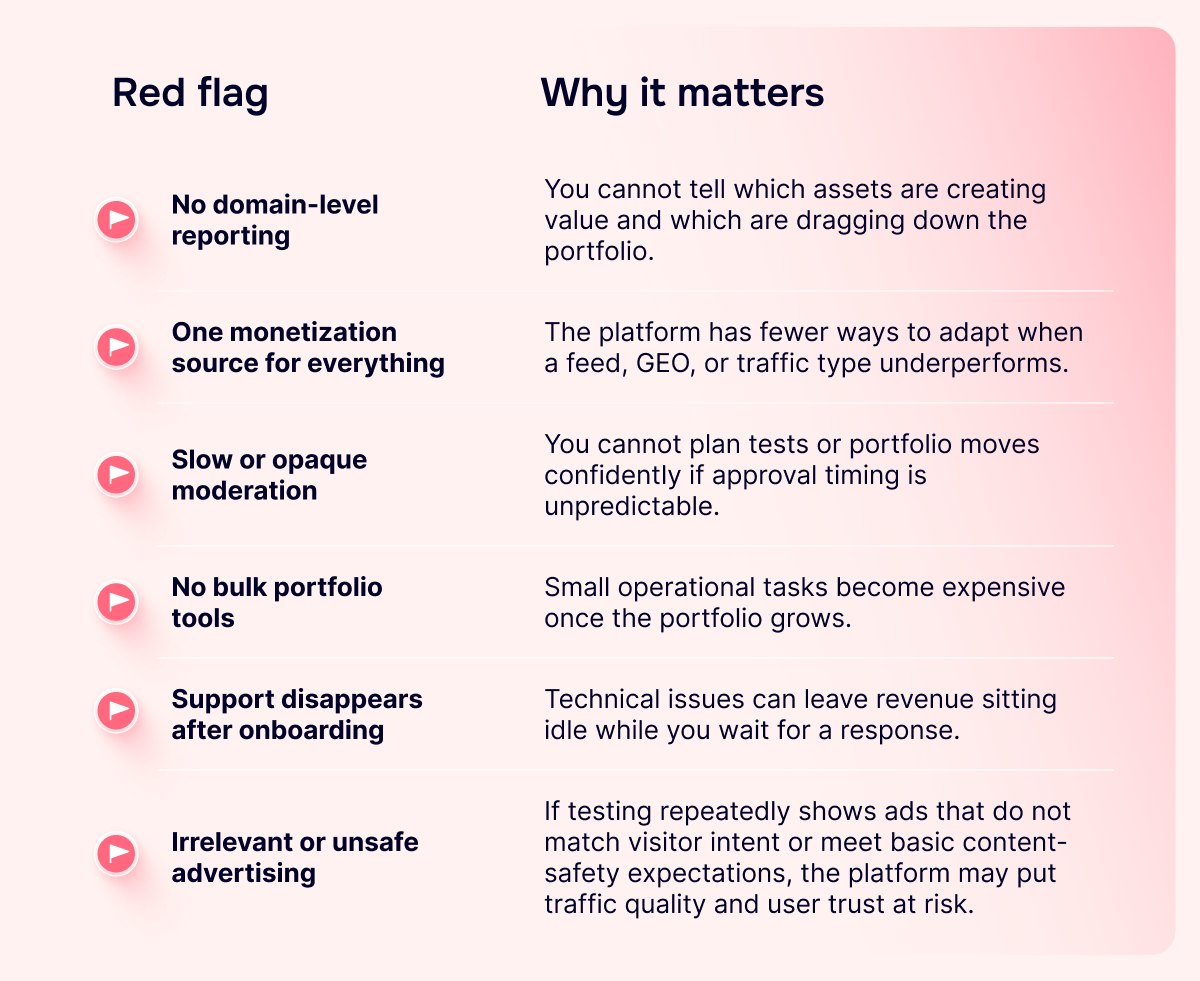
A platform can look convincing during onboarding and still become frustrating once real traffic starts flowing. A few warning signs are worth taking seriously:
What this looks like at RollerAds
RollerAds moved into domain monetization by adapting its existing traffic monetization and advertiser-demand infrastructure rather than building a brand-new parking ecosystem from scratch.
After Google removed parked domains from the Search Partner Network, that existing infrastructure could be adapted to parked, expired, and typo traffic. Today, RollerAds’ domain product combines monetization, domain-level analytics, portfolio tools, support, and domain sales in the same interface.
Currently, the RollerAds domain product has over 1.2 million domains monetized, over 100 domain partners and over 5.5 million clicks per day. That already puts the product at substantial scale.
And the product is built to cover the full workflow in one place: connect domains, monetize the traffic, track performance, manage the portfolio, get support, and list domains for sale.
How to begin monetizing domains with RollerAds
Getting started with your own portfolio is straightforward:
Step 1: Visit your RollerAds Dashboard or create an account if you are new to the platform and navigate to Sites > Domain Parking.
Step 2: Submit the one-time moderation request with information about your domain portfolio and traffic. A manager will review your submission and contact you through your preferred contact method.
Step 3: Once you have been approved, enter the domains that you would like to test. You can either type in each individually or upload a file containing multiple domains.
Step 4: After that, we will provide you with the DNS information required to connect your domains to our system. Depending on your setup, this can include Name Server (NS) or CNAME details. You then update the corresponding settings through your registrar.
Step 5: Once your domains have been configured and verified, monetization will start automatically.
Optional step 6: If you want to sell a domain, you can list it directly in the RollerAds platform while continuing to monetize it until it is sold.
You can then review performance, group domains by tag, compare results, and decide which parts of your portfolio to keep testing, expand, or sell.
The takeaway
The takeaway is simple: a domain monetization platform should make it easier to earn from your traffic and manage your portfolio at the same time. RollerAds gives you monetization, analytics, portfolio tools, support, and domain sales in one place.
Ready to put your domain traffic to work? Sign up for RollerAds, open the Domain Parking tab in the Sites section, and submit your portfolio for review. And if you need any help along the way—we are just a message away.