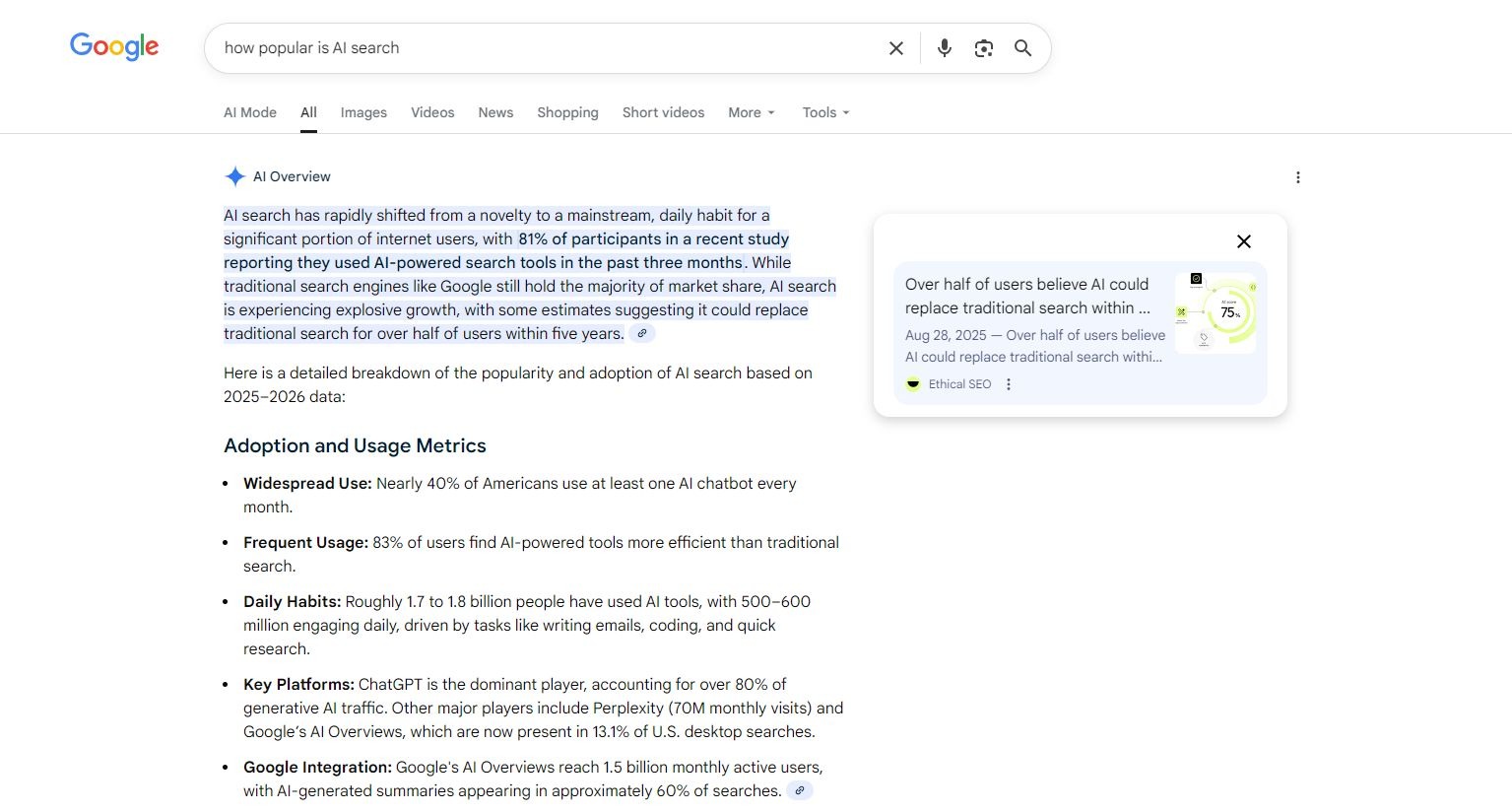
With the explosive growth of AI, regular Internet browsing is, while still relevant, becoming less prevalent. Instead of looking through numerous websites in search of the proper info, you can just ask a chatbot to give you the answer with all the necessary links. Or, if you prefer a more traditional browsing experience, the first result you often see when searching on Google is its AI Overview, which includes all the sources used to generate the answer.
In response to this shift, the concept of Generative Engine Optimization (GEO) has emerged. In this article, we’ll explore what GEO is, how you can improve AI outputs, and more. So, let’s get right into it.
What is GEO?
Generative Engine Optimization (also called AI SEO and GEO SEO) is a method of optimizing content for LLMs (Large Language Models) like ChatGPT, Gemini, or Grok, as well as AI-driven search engines, such as Google AI Overview.
GEO optimization is what you want to do if your goal is for your website to be recommended by AI whenever a user types in a query. Studies suggest that about 37% of users start their search with AI rather than Google. And the number is expected to grow, so GEO becomes rather a necessity to remain competitive.
What’t the difference between GEO and SEO?
In the earlier section of the article, we said that GEO can also be called an AI SEO, but the inclusion of “AI” in the term is a surface-level difference. So, for your convenience, we compiled this table for comparing SEO and GEO:
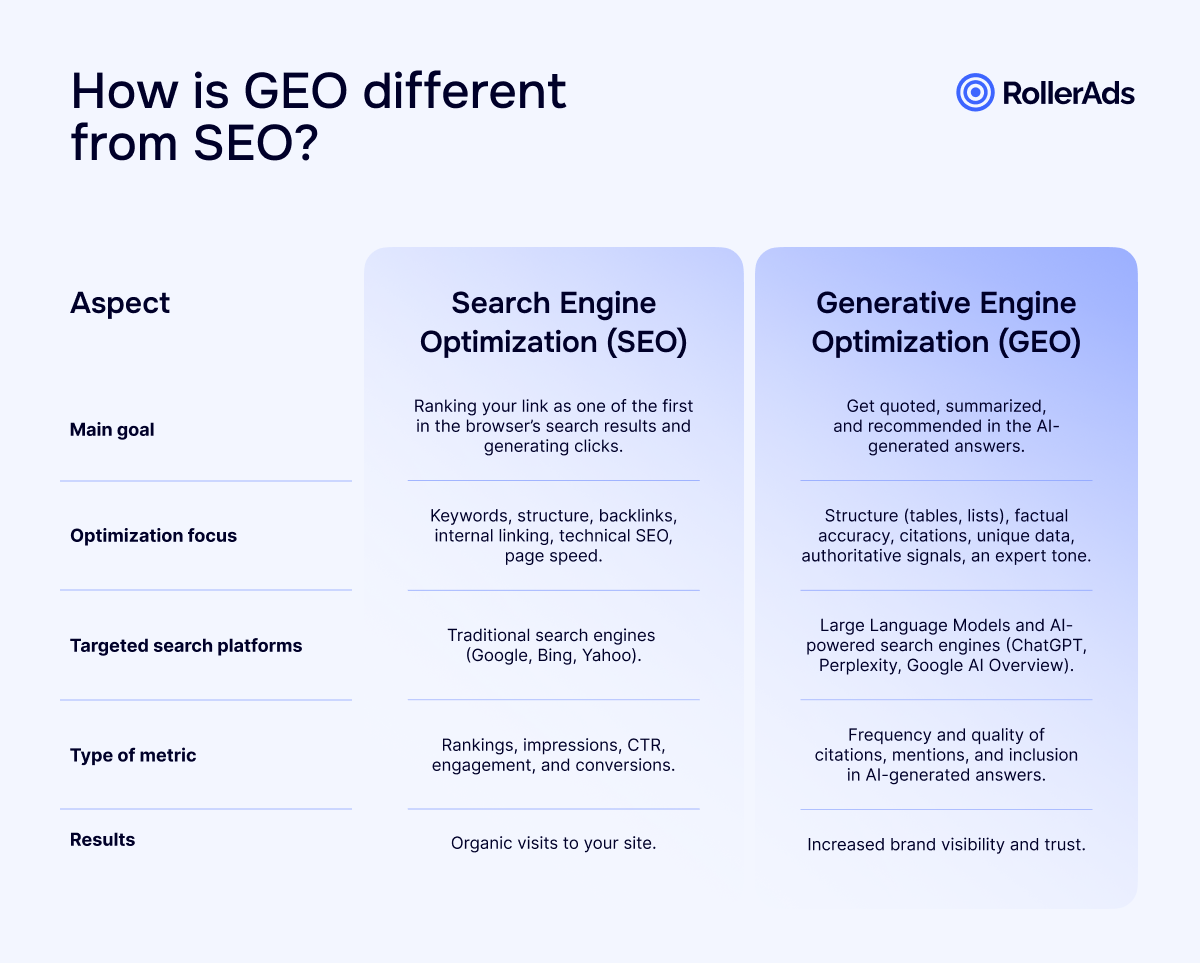
What needs to be said is that the existence of GEO doesn’t make SEO obsolete. Instead of sticking to one method or the other, we recommend combining them both. That way, your content will not only retain its human nuance and depth but also future-proof your brand in the era of AI-powered search results.
Why pay attention to GEO
Now that we know what GEO is and what differentiates it from traditional SEO, let’s take a look at the benefits that this optimization strategy brings to the table:
- Better content visibility. Structuring content effectively for AI recognition can improve the likelihood it appears in AI-driven search results.
- Higher-quality traffic. Optimizing content for AI-generated answers can improve the relevance of visitors from AI-driven sources, increasing the overall likelihood of conversions.
- Enhanced brand authority and trust. By providing high-quality, structured, and accurate information, you can establish your brand as a reliable source that AI models are more likely to cite and recommend to users.
- Competitive advantage. There’s no denying that AI is here to stay, so the early adoption of the new technology gives you a head start over competitors.

GEO strategies to use right now
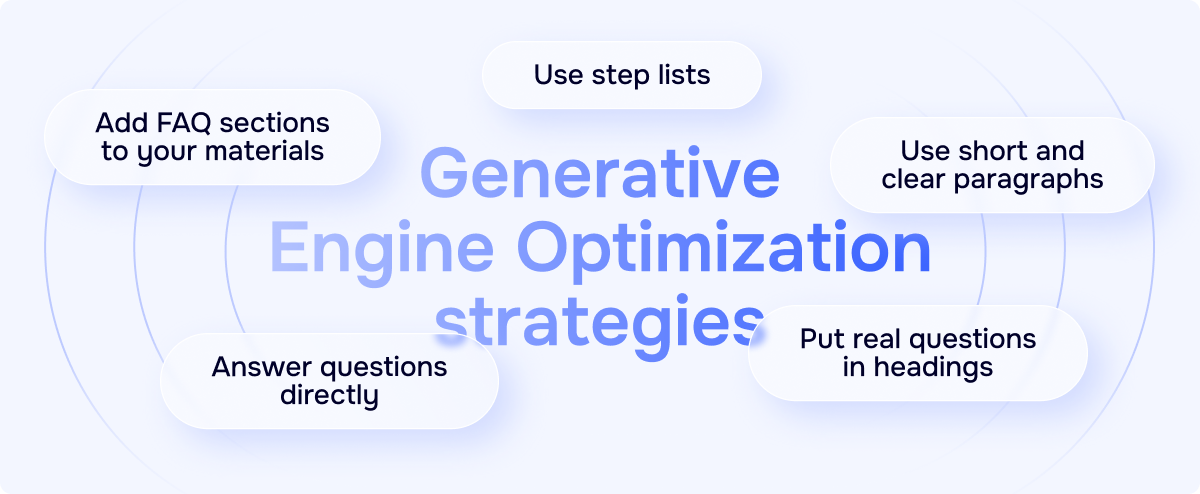
There are many ways that you can utilize this strategy to your advantage, so we created a list of the 5 most effective AI engine optimization techniques:
- Answer questions directly. Sometimes, an AI’s attention span is even shorter than the average modern Internet user’s, so the answer on your page needs to be succinct.
- Paragraphs need to be short and clear. AI often struggles to extract the main idea from long, complex chunks of text. If you want to bring more LLM traffic to your website, make your writing simpler.
- Use step lists when appropriate. Steps with clear points and directions are perfect not just for humans, but for AI too, for their overall structure and reusability.
- Put real questions in headings. People often use AI when they need to find out something quickly, so it will be best to use “how to”, “what is”, and other similar questions in your headlines.
- Add a FAQ section to your materials. FAQ sections with clear questions and short answers help AI systems locate and present relevant information efficiently.
Useful tools for LLM content optimization
Before we end, we would like to give some examples of top-notch tools for LLM content optimization:
- MarketMuse. An AI content optimization and planning platform that uses machine learning to analyze semantic relevance, topic authority, and coverage gaps—valuable for LLM‑focused content strategies.
- Scrunch AI. A tool for evaluating content readability for AI and recommending improvements to increase the chance that LLMs will cite your pages.
- Peec AI. Provides visibility tracking across AI language models and insights on how content performs in AI responses—helpful for monitoring and optimizing LLM content.
- Otterly.ai. Platform focused on monitoring and optimizing how brands and content are represented in LLM responses, helping improve visibility in AI‑driven search.
- Scalenut. Comprehensive LLM content suite that includes features like keyword research, topic modeling, outline creation, and content optimization with AI workflows.
- Geordy.ai. Generative Engine Optimization platform that prepares websites with structured formats (like llms.txt and JSON files) that are readable by LLMs—useful for technical LLM content readiness.
- Typedream. A CMS (Content Management System) with AI‑ready templates that include structured metadata and schema, designed to improve how generative engines interpret your pages.
- Adobe LLM Optimizer. An enterprise-level solution announced by Adobe to enhance content relevance and authority in AI‑driven discovery environments.
And here are some practical examples of how you can utilize them in your work:
- MarketMuse and Scalenut can be used to build strong topic structures and semantic depth so LLMs see your content as authoritative.
- Peec AI and Otterly.ai are perfect for measuring where your content is cited or referenced in AI responses, so you can adjust it accordingly.
- Geordy.ai and Typedream can help you prepare your site in formats that AI systems prefer.
FAQ: Generative Engine Optimization
In this section, you can find some popular questions regarding Generative Engine Optimization and answers to them.
What is Generative Engine Optimization (GEO)?
It is a strategy for optimizing content so that AI systems and AI-driven search engines (like ChatGPT, Google AI Overview, or other LLM-powered platforms) are more likely to reference, summarize, or cite your website’s content.
Is GEO similar to SEO?
Both SEO and GEO aim to increase content visibility, but they target different systems. SEO focuses on improving rankings in traditional search engines like Google for human users, while GEO focuses on optimizing content so it can be recognized, cited, or used by LLMs (Large Language Models) and AI-driven search engines.
What GEO strategies can I use now?
You can make your content more AI-friendly by:
- Structuring it clearly with headings and subheadings.
- Using short, focused paragraphs and step-by-step lists.
- Adding FAQ sections with concise questions and answers.
- Monitoring how often AI systems reference or summarize your pages.
These strategies improve the likelihood that LLMs and AI-driven search engines will cite or surface your content.
Conclusion
The rise of AI has transformed how users search for and interact with content, creating new opportunities for publishers and advertisers. Generative Engine Optimization (GEO), though a relatively new practice, helps make your content more visible and citable by AI-driven platforms and LLMs. While these tools offer clear benefits, they work best when combined with traditional SEO and content strategies to maintain quality, authority, and reach.
The future of AI-powered content is here, and RollerAds is ready to help you navigate it—combining advanced technology with hands-on support to maximize your traffic and revenue. Join now!