Starting a blog isn’t just about sharing your ideas and publishing content, it’s about building a digital asset that can generate long-term income. Thousands of bloggers have already turned simple websites into profitable businesses without a large investment or a team at the very beginning.
In this guide, we’ll focus on blogs built on your own website rather than social media or third-party blogging platforms like Blogspot. You’ll learn how to launch your blog website from scratch, choose the right monetization methods, attract readers, and grow your revenue.
Although success doesn’t happen overnight, with the right niche, consistent content, and a solid monetization strategy, your blog can become a reliable source of passive income.
Website-based blog explained
A blog is a website built specifically around publishing content regularly. What kind of content can be published? Anything, from PC building and tinkering to home decoration and cleaning. This flexibility is not limited to the topics, but it also applies to blog formats, since you can have:
- Listicles. Articles organized as numbered or bulleted lists (e.g., “10 Ways to Save Money”).
- How-to guides. Step-by-step tutorials that solve a specific user problem.
- Reviews. Honest evaluations or comparisons of products and services.
- Case studies. Deep dives into real data, projects, or client results.
- Thought leadership. Opinion pieces and expert insights on industry.
There can be videos, questionnaires, and other media, but the core idea of a blog is to feature relatively long texts for reading. A good blog is one that is interesting to read, no matter how long the materials are, thanks to succinct paragraphs, pictures, and a structured flow of thought.
Blogging is a somewhat cost-efficient endeavor. Yes, you have to pay for hosting and maybe a number of tools to ease your writing, but that’s it: You can do it at home or while at the park, you can do it perfectly on your own or hire more writers, you can work whenever you want and as much as you want.
So let’s start from the very beginning.
Step 1: Choose the right niche
Blogging can be based on any topic, as long as you’re passionate about it. In fact, it’s better to pick an obscure direction that you’re genuinely passionate about and give it your spin instead of trying to ride the hype and write about promising niches that don’t resonate with you.
Right now, the following niches tend to be more popular and content-rich. You might want to explore them, but only if they align with your interests. If not, it’s better to stick to a topic you’re passionate about.
- Home décor
- Lifestyle
- Recipes and food
- Personal finance
- AI & technology
- Entertainment
It takes time for the blog to take off, but once it does, you’ll eventually hire writers. If by that time you haven’t started paying attention to quality, you will have to learn that skill the hard way, because Google pays a lot of attention to E-E-A-T (Experience, Expertise, Authoritativeness, Trustworthiness).
Being E-E-A-T-compliant is all about originality and credibility. Thin rewrites of other people’s content rarely rank for long, so that’s why we mentioned “giving your own spin” earlier.
Step 2: Pick the name and domain
There’s generally one big rule: the good blog should have a clear name that communicates immediately what it will be about. There are more nuances though:
- Keep it short and easy to remember.
- Avoid numbers and hyphens.
- Prefer a .com domain. If it’s taken, .co is usually the next best option.
Your domain name is more than just a web address, it will become your brand as your blog grows. Choose a name that’s easy to recognize, simple to type, and relevant to your niche.
You can register your domain through any reputable registrar, such as Cloudflare, Namecheap, or GoDaddy.
Once you’ve secured your domain, it’s time to think about your blog’s design. We won’t cover that in detail here, as it deserves a separate guide of its own, but keep in mind that a clean, intuitive design makes your content easier to read and leaves a better first impression. If design isn’t your strong side, there are also plenty of AI tools that can help you create a professional-looking blog.
Step 3: Complete the technical setup
Generally, there are 3 steps in the technical part on how to set up your blog. While there are some alternative methods, this one is somewhat the most tried-and-true, common, and field-tested. Consider it as a template:
- Choose a self-hosted CMS (Content Management System). We recommend WordPress, as it is free and flexible.
- You need web hosting to store your page, anything like Bluehost.
- Select and customize a WordPress theme. It doesn’t have to be fancy, but it ought to be unique.
Once your site is live, make sure you set up the necessary analytics and tracking tools. This will help you monitor your traffic, understand how users interact with your website, and track your progress over time. It’s also important to ensure that search engines can properly crawl and index your pages, as building organic traffic takes time.
For managing third-party tools and tracking codes, you can use Google Tag Manager or another solution that fits your needs.
Earlier, we created a detailed guide on how to set up a blog on WordPress. Make sure to check it out.
Step 4: Start driving traffic
Between setting things up and monetization, there is the process of acquiring users. Organic users are among the best, but proper SEO takes time, so it’s rarely enough on its own.
From the very first day, you should think about omnichannel promotion. Social media is a great place to start; for example, you can run parallel accounts on Pinterest, Instagram, Facebook, X, or wherever else your audience hangs out.
Partner with other sites for guest posts and cross-promotion to build both backlinks and referral traffic. And of course, paid traffic is a great way to get an influx of traffic fast. Basically, paid and organic traffic are two extremes, but they don’t have to be at odds: combine them to create a synergy.
Oh, and don’t get lost in acquisition, because there’s retention, too. People who already know your blog are more valuable than brand-new visitors. Use email, push notifications, and on-site recommendations to bring them back and increase page views. Higher engagement often means more ad impressions and better monetization.
For a deeper look at traffic growth tactics, check our earlier article: Traffic growth tips for modern publishers. And explore our guide on driving traffic to and monetizing WordPress websites.
Step 5: Explore ways to monetize your blog
When it comes to exact ways of how to monetize your website, there are some options you can choose from. The best thing is that you can combine them freely.
Promoting products through affiliate programs
You can earn commissions by recommending products or services relevant to your audience. Just join an affiliate program (like Amazon provides), get a unique tracking link, and place it in your content, such as reviews, comparisons, tutorials, or recommendations. When users make a purchase or complete a required action through your link, you receive a commission.
Ad network advertising
If you want to focus purely on developing your site, then you might want to delegate advertising to affiliates, or as they’re called in ad networks, advertisers. Basically, what happens is you lend a bit of space on your website to ads run by advertisers on ad networks.
You can theoretically bypass the middleman and work with affiliates directly, but technical challenges will arise. Plus, you will have to negotiate all the deals manually and discuss payment terms. If there are a few advertisers, an ad network is a superior choice thanks to the standardization of code tags that enable ads.
Direct ad sales
We’ve mentioned it briefly above: you can run direct sales of ad spots. Perhaps you have a particularly good advertiser or strong brand. Just be mindful that, unlike ad networks that still give you control over what kind of ads end up on your website and how frequently, direct sales imply that you’re your own boss.
Sponsored content
Sponsored content is another form of direct collaboration with advertisers. Instead of simply placing an ad, you create content that features or promotes a brand, product, or service. This can include sponsored articles, product reviews, tutorials, or newsletter mentions.
The most important thing is to maintain your audience’s trust. A paid partnership should still feel relevant and useful to your readers. Promoting something you don’t believe in can damage your credibility.
Selling your own products or digital downloads
A website might be tied to tangible goods. If you make figurines out of clay, you can sell them, which is pretty straightforward. But even if your website is more about intangible things, like information and estimates, e-books, templates, online courses, checklists—anything that solves a specific problem for your readers will do as well.
Margins are usually much higher than affiliate commissions, but you have to dedicate time to creating such products, besides blogging.
Memberships and subscriptions
Does “full access on Patreon” sound familiar? Well, that’s a pretty basic way to introduce membership and subscriptions to your tier-based system of users. Offer exclusive content, community access, or tools behind a paywall.
This works best when you already have a loyal audience. It doesn’t have to be anything big; just provide a complete version of something. If you teach the guitar, then lock musical sheets behind a paywall, stuff like that.
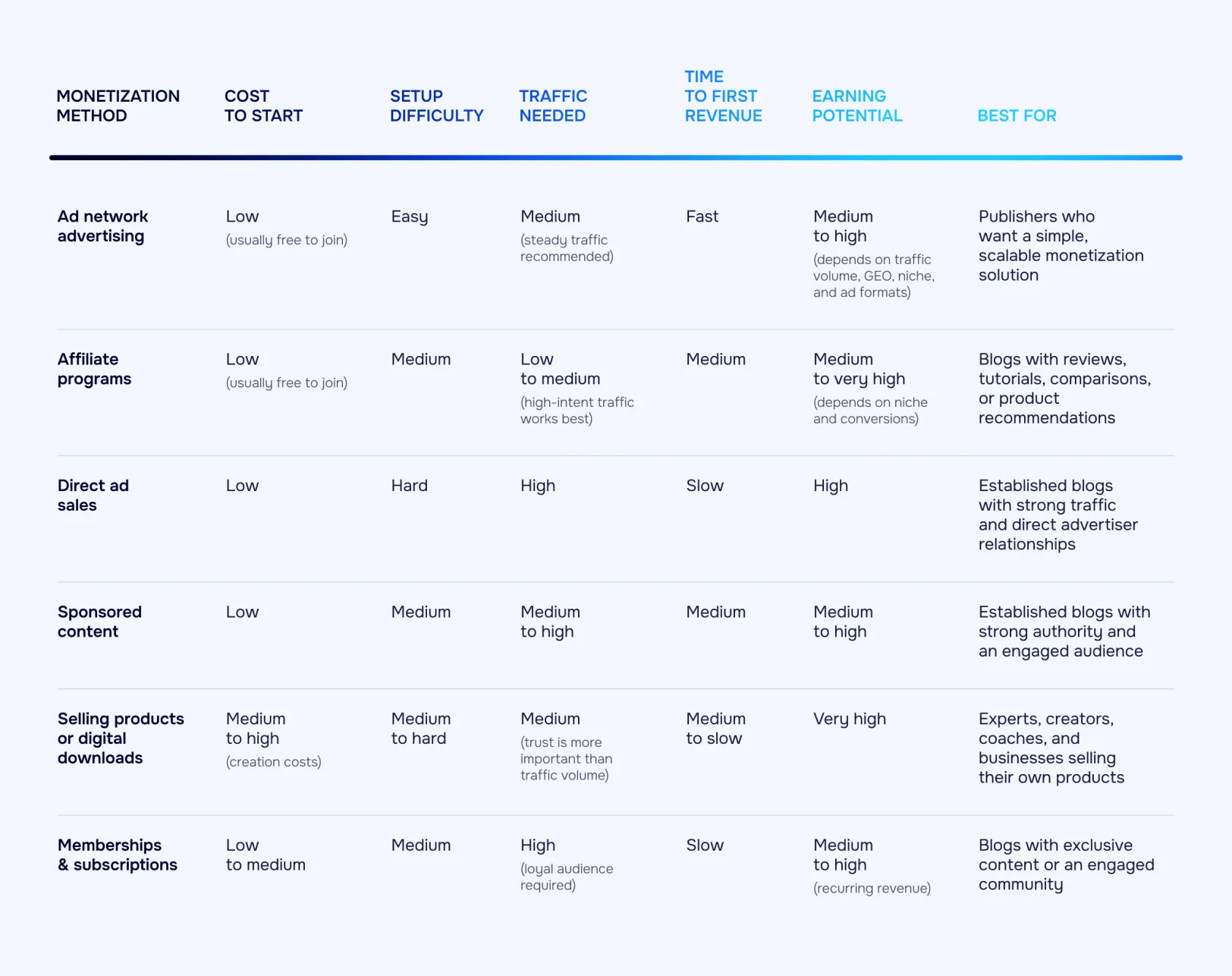
To help you compare your options, we’ve put together a table showing how each monetization method differs in terms of setup, costs, traffic requirements, earning potential, and the type of blog it’s best suited for.
Key takeaways:
- If you want to start earning quickly: Choose an ad network.
- If you want to maximize revenue from your content: Try affiliate marketing.
- If you’re looking for the highest profit margins: Sell your own products or digital downloads.
- If you have a loyal audience: Introduce memberships or subscriptions.
- If your blog has established authority: Consider sponsored content and direct ad sales.
- For the best long-term results: Combine several monetization methods instead of relying on a single income source.
💡 Pro tip: The most successful blogs rarely rely on a single income source. A common progression looks like this:
Ad network + Affiliate marketing → Digital products → Sponsored content + Direct ad sales
As your audience grows, you can layer new monetization methods on top of existing ones instead of replacing them. This creates a more stable and diversified income stream and reduces your dependence on any single partner or revenue source.
How RollerAds can help with monetization
Our team has been working with website and blog monetization for over a decade, even before RollerAds saw the light of day in 2019. We know how each website can achieve the highest possible revenue, given its topic, audience, and GEO; based on all these criteria, we create a personalized monetization plan.
We help thousands of publishers grow and enhance their businesses. That said, you can check out the case study with one of our clients. Together, we managed to achieve $60,000 per month in revenue in just four months, starting from $0.
RollerAds is built specifically for publishers who want more control and better results. For website and blog monetization, we offer several ad formats designed to fit different traffic types and user experiences.
Push notifications
Push notifications are a permission-based format that allows publishers to monetize their audience beyond the website visit. These messages can be used to share different types of offers, promote products or services, notify users about discounts and special deals, or encourage them to take a specific action.
Custom push messages: engage your audience beyond monetization
With Push notifications, apart from ads, publishers can use custom messages to communicate directly with their subscribers. These messages help turn one-time visitors into returning audiences by notifying them about new publications, important updates, or recommendations. Think of it as giving your readers a friendly nudge instead of hoping they’ll remember to come back on their own.
OnClick (Pop ads)
OnClick is a high-performance format that works separately from your website’s layout. It opens an ad page in a new browser tab or window, making it hard for users to miss. The format is monetized on a CPM basis, meaning you earn revenue for every impression, with no clicks required.
Unified dashboard with simple and intuitive navigation
Another selling point of RollerAds is flexibility. We have recently rolled out a unified dashboard, meaning if you ever decide to grow further and start advertising products yourself, you won’t have to leave your publisher’s account.
At RollerAds, we understand the value of each user generated, and we take all the necessary steps to keep your SEO efforts intact. There are ad frequencies and category selection to make sure you command what is shown, when, and how frequently. Your website is your asset, but we will protect it and its performance as if it were our own.
Final thoughts
Starting a blog today is quite easy—just follow the steps above. However, turning that blog into a profitable business takes time, consistency, and continuous improvement.
When it comes to monetization, don’t limit yourself to a single method or partner. Test different approaches, combine several revenue streams, and analyze what works best for your audience. A successful blog can use multiple monetization channels at once: ad networks, affiliate marketing, selling products, subscriptions, or sponsored content. Also keep in mind that ad formats might have unconventional uses. Push notifications, for example, can do double duty: They generate revenue and help you promote your own content to existing subscribers.
The same applies to advertising partners. Different networks and formats work better for different goals, so it’s worth experimenting and finding the right combination for your website. Keep an eye on market trends, explore new opportunities, and adjust your strategy as your audience grows.
You don’t have to figure everything out alone. Experienced partners and account managers can help you understand your traffic better, choose the right monetization setup, and find ways to increase revenue without hurting your user experience or SEO. At RollerAds, our managers are always ready to share their expertise, suggest additional monetization opportunities, and help you build a strategy that fits your website’s needs.
Your blog is a long-term asset. With the right approach, continuous testing, and the right support, it can grow from a simple website into a sustainable business.