Very few things in life are safe from fraud. As long as there’s a moral hazard with an incentive to profit big by playing unfairly, there will be malevolent actors willing to seize the opportunity. And affiliate marketing is no exception.
No need to despair, though, as reputable advertising networks, like RollerAds, work hard day and night to protect their partners from ad fraud. Don’t get us wrong: you still need to be vigilant, but at least you’re not alone in your quest for fair and just payouts.
In our previous article, we explained the different types of fraudulent traffic and the consequences they can have. Today, we’ll show you how to detect invalid traffic and what to do if you spot it. Let’s get the ball rolling!
Signs you’re receiving invalid traffic
As the saying goes, forewarned is forearmed. You can only deal with fraudulent traffic if you spot it early. Let’s go over the most common and reliable signs that indicate your website is receiving invalid traffic. Here’s what to look out for:
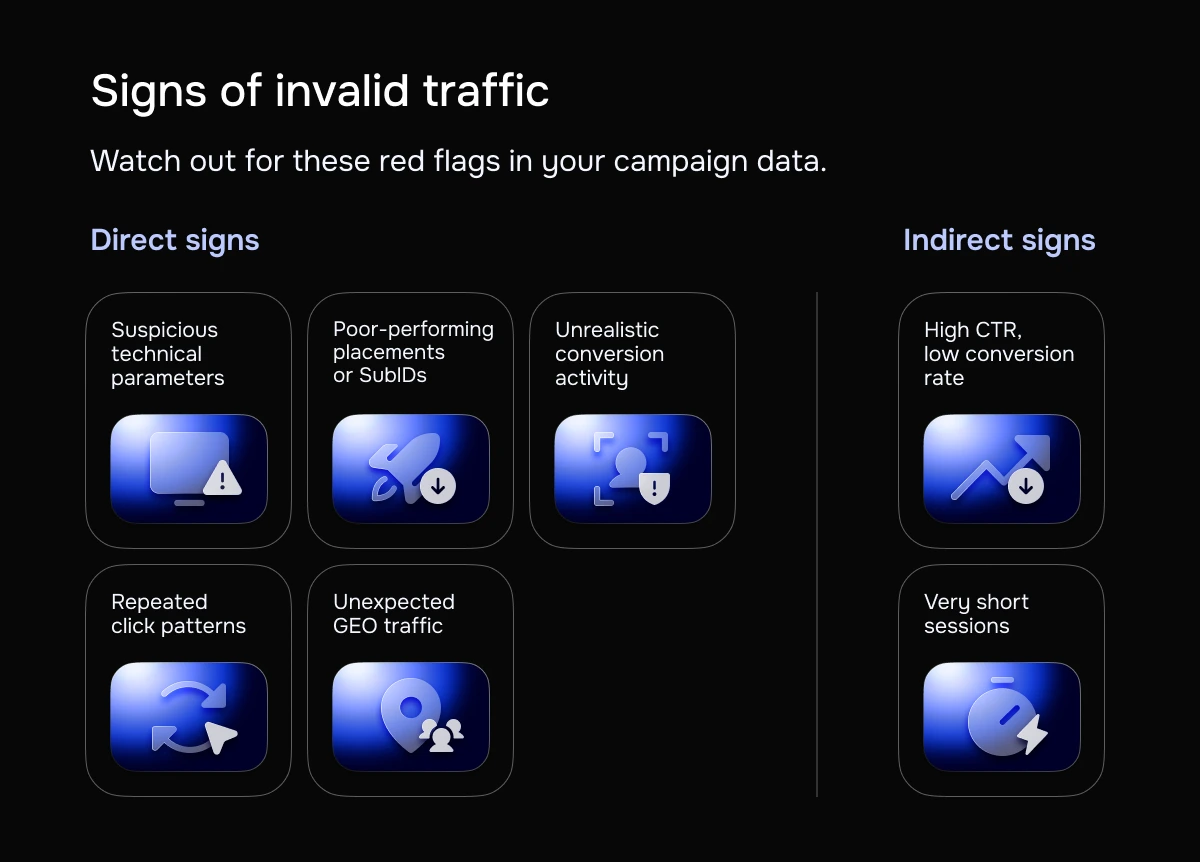
Below, we’ll take a closer look at each of these warning signs groups and explain what they may indicate in practice.
First, let’s look at direct signs—the objective indicators that show high likelihood of fraudulent traffic:
- Abnormal frequency and repeatability. Bursts of clicks in short periods, equal intervals between actions, and multiple instances of them being done from the same IP, device, or user agent.
- Mismatch between GEO and campaign settings. Traffic comes from non-targeted countries, data centers, VPNs/proxy, or from a GEO that does not match the targeted source.
- Strange technical parameters. Outdated or rare browsers, empty/referrer anomalies, identical screen resolutions, disabled JavaScript/cookies, suspicious user agents.
- Poor quality across websites and subID. One zone, placement, or subID shows significant differences in CTR, CPA, time on site, or post-click activity. To figure out what is happening, you need to compare sources within the same attribution window.
- No subsequent behavior. Real users typically have similar behaviors: returning, viewing multiple pages, and completing certain actions after the first visit. Bots strictly follow the “click → action → disappearance” plan.
- Unrealistic conversions. For example, there are many registrations but almost no email confirmations, profile completions, repeated sessions, or payments. This could be fraudulent activity that simulates simple target actions.
The next signs are indirect. Although they may indicate fraud, when encountered separately without any other signs, they are rarely compelling reasons to think it’s invalid traffic. More often, they point to issues with the funnel, but not the traffic itself.
- Suspiciously short visits. High bounce rate; users spend only several seconds on the website; only one page is viewed; no scrolling; and other identical, recurring scenarios.
- Lots of clicks with almost zero completed target actions. The CTR may be high, but the number of registrations, deposits, purchases, or other target actions is noticeably lower than usual.
When reviewing data from the traffic channel, you must treat the features listed above as a package. It can be suspicious if you notice one or two signs, but if the source overall performs well, you need to monitor it further to see if those were just some hiccups or a trend.
However, if those features of invalid traffic persist, or worse, you observe most or all of the signs listed in this section, you have definitely encountered ad fraud.
What to do if you suspect poor-quality traffic
Now, if you suspect you’ve encountered ad fraud, you must do as follows:
- If you work with RollerAds (or any other well-known, trustworthy advertising network), contact the support team or your personal manager immediately.
Basically, this is it, but to help the network’s team speed up the process of eliminating the malicious traffic channel, don’t forget to also:
- Check the domains (whether they open and redirect; whether the links open), and go through the funnel yourself from start to finish.
- Provide the tracker stats, clicklog (agent, IP, etc.), and LP CTR.
We can, of course, investigate even without tracker data, but it can give us valuable clues to figure out the problem faster. That’s why we highly advise you to set up a tracker in advance and use it with all your campaigns.
Learn how to set up a postback with the most popular trackers in our step-by-step guide. Check it out to see how it works and why you need it.
And as we said at the beginning of this article, all reputable ad networks care about their partners and their reputation in the business; that’s why they thoroughly check every source before adding it to the platform and won’t knowingly sell their partners invalid traffic.
But there’s always a possibility that a fraudulent channel could sneak through, so it won’t hurt to know what to do if you encounter one. After all, there’s a reason why everybody knows what to do in case of a fire alarm, even though all public places are built in accordance with the latest fire safety regulations.
And if you do become a victim of fraud, it’s in the ad platform’s best interest to get a handle on the situation. So there’s no need to worry. Even in the worst-case scenario, if you have evidence in hand, you’re protected from financial losses. It’s common practice for ad networks to reimburse the funds in full if fraudulent traffic slips through. Besides, the invalid traffic channel will be blocked without the possibility of appealing the decision.
In conclusion
Here at RollerAds, we continuously improve the quality of our traffic. The platform has an advanced anti-fraud system that instantly flags and blocks bots and invalid traffic, and our team regularly adds new metrics to more quickly spot malicious traffic sources.
Despite advertising networks’ efforts to prevent ad fraud, it remains firmly entrenched in the digital marketing industry and can still occur. If you have any suspicions, feel free to contact us because RollerAds is always here to listen and help you, no matter what.
If you’re looking for a reliable advertising platform with a strong focus on traffic quality and fraud prevention, RollerAds is here to support your campaigns.